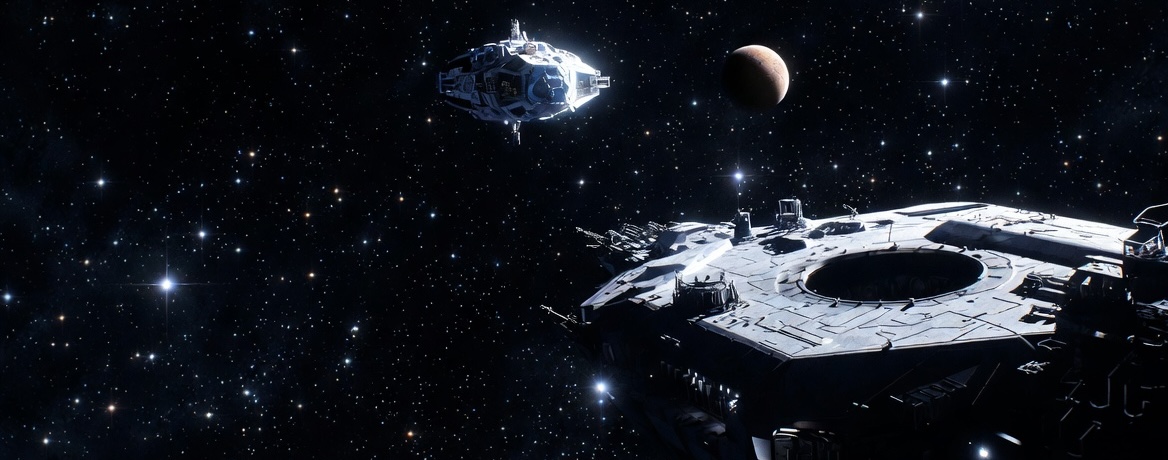
Odyssey’s Journey – Chapter 1 – The Verya Encounter With The Vorrak
6 Months Prior To First Contact With Earth V2
The void was never truly empty, not in the coreward fringes where the stars grew sparse and the darkness between them thickened with both possibility and danger. Aboard the Vorrak heavy cruiser Krag'thul, Captain Vorath-Kai stood on the command deck, his broad, armored frame casting a long shadow under the harsh crimson lights.
The Vorrak were built for war: squat, heavily muscled bipeds with thick gray-green hides scarred from ritual combat and plasma burns, four-fingered hands ending in blunt claws, and eyes like polished obsidian set deep in ridged skulls. Their ships reflected that—brutish, angular, plated in ablative ceramic, and bristling with railguns and kinetic lances. No elegance—only function. Efficiency was for the weak.
The tactical holotank flickered as the sensor ghost solidified into certainty: a single ship, sleek and elongated, speeding intensively toward the hyperspace threshold. Unknown design. Not Vorrak. Not one of the fractured Accord remnants they usually hunted. No weapons signature, no heavy armor plating. Just speed, and now—impossibly—acceleration that mocked their own engines.
Finally, they located the ghost ship they had been searching for over the last six time frames. All efforts to find the ghost ship had been unsuccessful until one of the ground parties accidentally found it, and accidentally was the right word since they weren't looking for it but were searching for loot in the bombed-out city of Ruka-Kng. Fortunately for them, they found it because their absence had been noticed, and they were marked for discipline.
“Power curve spiking,” the sensor officer growled, his voice gravelly through his respirator mask. “Drive signature unknown. Not military. Too clean, too fast. Spy vessel? Exploration scout? It entered our space months ago and landed somewhere on Ruka-Kng. We scorched it years back after the population rose up in revolt. We assumed it was probing for weakness or mapping our borders. We were wrong. It’s fleeing.” Vorath-Kai’s mandibles clicked in irritation. “Target the drive spines. Disable, do not destroy. We want them alive—whoever they are, and what they intend will be painfully extracted.”
The Krag'thul moved ponderously, aligning its forward batteries. A salvo of kinetic slugs—dense projectiles—filled space. Too late: “They’re jumping,” the weapons officer snarled. “They’ll make the fold.” Vorath-Kai stared at the holotank, claws flexing. Whatever that ship was—spy, explorer, scavenger—it had come from the dead world they had bombed to ash, lingered in secret, and now fled outward with a speed no Vorrak ship could match. It is a mystery that must be solved. Who is this mysterious ship?
“Last heading noted,” he said. “Extrapolate vector. Full sensor sweep on residual wake.”
The navigation officer complied. Lines of probability spread across the display. Coreward vectors were initially dominant, but the clearest path curved outward—toward the galactic rim.
“Outward,” the officer reported. “Sparse region. Heading toward one of the few K-type suns in that sector. Habitable zones are narrow. Low chance of an advanced world.”
Vorath-Kai’s eyes narrowed. K-type stars—orange, long-lived, stable—were rare out here. It looks like they are heading for one of the few systems capable of sustaining life.
“High Command will not be happy,” he ordered. “They will not be satisfied when I report that the intruder escaped.”
The Krag'thul slowed, turning to start the long, inefficient spiral back toward a resupply depot. The Vorrak hyperdrives would kill another crew generation before they could follow—but they would follow anyway.
Eight periods later, deep in the fortified orbital yards above the Vorrak homeworld, High Command gathered in the iron-domed war chamber. The chamber reeked of ozone and hot metal; holographic star maps drifted slowly overhead, with red threat vectors pulsing like wounds.
High Marshall Grath-Vor listened silently to Captain Vorath-Kai’s after-action report. When the captain finished, Grath-Vor spoke in a deep, rumbling tone reserved for final orders.
“The intruder entered our space undetected, lingered on a world we had already cleansed, and left with capabilities beyond any known scout vessel. I suspect it was not a coincidence. It found something—technology, resources, who knows. Without knowing who they are or what their intentions are, we must pursue.”
High Marshall Grath-Vor turned to the chief engineer, a scarred veteran whose left arm had been replaced by a crude prosthetic claw.
“Build two autonomous hunter-killers. Strip away every unnecessary system. Mount the most powerful engines we can forge—overclocked, short-life cores, just enough for them to reach the K-star.
“Equip them with our latest AI ayatwm. Give them sensor suites to track residual wakes across decades if necessary. Arm them with our most powerful weapon and program it for kill on sight.”
The engineer nodded. “And recording?”
“Full archival redundancy,” Grath-Vor said. “Each probe will carry dual black-box cores—armored and radiation-hardened. Every scan, every visual capture, every intercepted emission, every anomaly detected will be logged and relayed by the fastest drones we can produce. If they find the intruder, if they reach its destination, if they encounter new threats or prizes—we must know.”
The engineer’s prosthetic claw clicked in acknowledgment. “It will take three cycles to construct. The engines will burn out after two jumps—maybe three. But they will reach the edge. And whatever they find there... will be recorded and returned here.”
Grath-Vor’s obsidian eyes gleamed. “Then let them burn. The Empire does not forgive trespass. And it does not forget. Ensure that you do not fail. One more thing. Inform our researchers. Give them this mandate: Improve our hyperdrives, or they and all their relatives and friends will be retired to the infinite void. Tell them they will have access to all necessary resources to complete the task. Failure is not an option. Somewhere in that darkness, the unknown ship had vanished.
High Command had just unleashed the hounds—two cold, relentless machines, each carrying the unblinking eye of the Vorrak Empire in their armored data hearts.
And the hunt—mechanical, patient, unfeeling —had begun.
Odyssey’s Journey – Chapter 2 – Earth Orbit
**Chapter 2** (Revised & Polished – Diplomatic Push)
The conference module aboard the Verya had settled into a peaceful hush, the golden light softening as Earth’s terminator line crept across the viewport below. Coffee cups sat empty, nutrient pods mostly untouched, and the faint metallic hum of the ship’s environmental systems provided a steady backdrop. The feeling of the Vorrak threat hovered in the air like humidity before a storm—distant, heavy, impossible to ignore.
Thren Toranki straightened, his amber eyes focused. “We have debated guests versus immigrants long enough. There is no time for the usual bureaucratic process—visas, hearings, background checks that would take years—while the Vorrak will be visiting our Solar System. It is not a matter of if, it is when, and with what. If they arrive in force, paperwork will be the least of our worries.”
Elena nodded slowly. “If you’re right, Earth is nowhere prepared. In fact, they do not have a clue they are in danger.”
Sophia’s grin flashed—sharp, eager. “And while you’re in the Oval Office charming the socks off the Secret Service, we hit them with the real ask: authorization to establish a Space Defense Force. Right now. Not in five years, not after another budget cycle. Led by you, Captain Thren Toranki, because no one else on this rock knows how to spot, track, and politely discourage a Vorrak incursion.
“We start small—patrol interceptors, sensor nets, a tripwire constellation in the outer system. If, or when, they arrive, we need to have some kind of opposition force ready.”
Elena raised an eyebrow. “You want to pitch an interstellar navy to the President on day one?”
Sophia shrugged. “Maybe not a full-on fleet, but we need eyes out there with some sharp teeth. We need to take advantage of the goodwill we have from medical advances and the availability of electricity. Use it now before the public and the government forgets. So yes, go big. Besides, the public’s already calling him ‘Space Dad.’ Lean into it.”
Thren’s mouth curved into that subtle Kaelith almost-smile. “Our crew needs to get off Verya They have been there far longer than the usual time for such confined spaces. I will insist that my crew be allowed to go planet-side. The Verya requires extensive maintenance that will need dry-dock time, including some upgrades. However, if I am correct, Earth does not have a dry dock, so that issue needs to be addressed. We can't stay in this orbit much longer. Our environmental systems, along with other critical systems, need an overhaul. My team needs gravity, fresh air, and a place to call home—somewhere private and hard to access would be ideal.”
Sophia jumped in before Elena could respond. “An uninhabited Hawaiian island. Make it part of the package. Restricted landing zone, airspace, and harbor. Allow environmental oversight so the activists don’t riot.
“It is also crucial for Thren to convince the Air Force that expansion into space benefits them, so he needs to establish a presence at a major Air Force base—like Air Combat Command (ACC) in Virginia.”
Elena exhaled through her nose, half amusement, half resignation. “You two are going to give the White House staff heart attacks. But… it’s not a bad move. Direct presidential access skips layers of red tape.
“If the President buys in, the rest of the government follows—or at least pretends to. And Hawaii? I still have a hard time with it.”
Thren inclined his head. “Then it is settled. I will prepare a formal request for an audience. You will transmit it through secure channels. We ask for the meeting within the next seventy-two hours—time is not our ally.”
Sophia stood, already energized. “I’ll draft the talking points. Short, punchy. ‘Hi, Mr. President. We brought you free energy and medicine. In return, we’d like a space force, a tropical home, and permission to be humanity’s first line of defense against space jerks. Mahalo.’”
Elena shot her a look. “Maybe soften the ‘space jerks’ part.”
“Fine. ‘Uninvited stellar neighbors.’ Better?”
Thren allowed himself a quiet chuckle—the sound surprisingly warm and human-like. “I will trust your cultural nuance. But emphasize the urgency. The Vorrak do not negotiate, nor are they known for their patience.”
Elena pulled out her comm tablet. “I’ll send the request up the chain now. Marked Priority Alpha, eyes-only to the National Security Advisor first. If they green-light it, we’ll have a sit-down in days—probably at a secure site stateside, then shuttle you down. No fanfare, no press until after.”
Sophia offered a big smile. “And when the President says yes—and he will, because who turns down ‘Space Dad’? We start with design plans for the interceptor. I want first dibs on testing the prototype: it must be fast and have big guns.”
Thren regarded her with fond exasperation. “One step at a time, Sophia Chin. First, we meet the leader of your world. Then we discuss Zoom and Boom.”
Elena tapped send. The message vanished into encrypted channels, racing toward Washington.
Outside the viewport, Earth kept its slow rotation—peaceful, unaware, and about to face the strangest diplomatic visit in history: twelve very human-like explorers requesting a presidential audience, a space navy, and a quiet spot in Hawaii to repair their ship and possibly save the planet.
Somewhere in the Oval Office, a staffer’s phone was about to buzz with the most surreal email of their career.
And Thren Toranki, lifelong pacifist and accidental galactic celebrity, simply folded his arms and waited.
The galaxy had a way of accelerating plans.
Especially when it smelled like plumeria and plasma cannons.
Odyssey’s Journey – Chapter 3 – Space Force - Maybe
The Oval Office smelled faintly of polished wood, fresh coffee, and the nervous sweat of aides who had spent the last forty-eight hours rewriting briefing books titled things like “First Contact Protocols: Alien Edition” and “How Not to Piss Off the Guy Who Gave Us Free,” Energy.”
President Elena Vasquez sat behind the Resolute Desk, sleeves rolled up, looking exactly like someone who had been awake for thirty-six hours straight but was still trying to project calm authority.
Flanking her were the National Security Advisor, arms crossed with eyebrows permanently raised; the Secretary of Defense, quietly calculating how he could counter alien technology if things went wrong; and a single Secret Service agent who kept glancing at the door, as if expecting Thren to burst in with tentacles.
The door opened. Captain Thren Toranki entered first—tall, bronze-skinned, amber-eyed, moving with the easy grace of someone who had spent years on exploratory vessels rather than parade grounds. Behind him followed Elena Reyes and Sophia Chin. Sophia, dressed in civilian clothes, wore the kind of grin that indicated she was already mentally commanding a destroyer. Elena appeared professional, though mildly amused by the sheer absurdity of the moment. Thren stopped three paces inside, inclining his head in a gesture that was both respectful and regal.
“Madame President,” he said, voice calm and controlled through the subtle implant that made his English sound almost too perfect. “Thank you for receiving us on such short notice.”
Vasquez stood, moved around the desk, and extended her hand confidently. “Captain Toranki. The pleasure—and the surrealism—is mine. Please, have a seat.”
They settled into the facing sofas. Thren took the middle spot, with Elena Reyes and Sophia on each side like wingmen. The President’s team stayed standing a moment longer than necessary, as if waiting for the other shoe to drop.
Vasquez broke the ice first. “I’ve read the briefings. Clean energy grids are operational in thirty-seven countries. Cancer remission rates have increased by eighty percent in trial groups. And now you’re here to ask for… what, exactly?”
Thren looked her in the eyes. “Time is short, Madame President. The Vorrak—the species that damaged my ship and forced our arrival here—are not expansionist; they are conquerors. They do not negotiate. They do not know the word. There is just one way for them: to subjugate or obliterate. For them, there is no in between. I am 99% sure they will probe this system. When they do, Earth must be ready to respond—with a strong defensive force.”
The Secretary of Defense cleared his throat. “Just what are you proposing?”
Thren looked the Secretary of Defense in the eye. “A Space Defense Force—small at first. Ten interceptor patrol ships and 30 sensor platforms that serve as early-warning tripwires in the outer system.
I offer my ship, the Verya, and myself to lead it, at least in the early stages. Building the small interceptor fleet will not be a major issue. We have fabricators capable of producing the most advanced components for both the interceptor and sensor units.
The SecDef leaned forward. “And your ship? I thought the * Verya needed repairs.”
Thren nodded. “True. Mostly maintenance caused by extended use. With raw materials and additional personnel, our fabricators can produce all the necessary components for the job. It will be fully operational by the time the senior units need to be deployed. The Verya will then serve as the base of operations for proof of concept for the first interceptor.”
The President looked at her advisors. The Secretary of Defense appeared as if he had just tasted a lemon. He was already mentally redrawing budget lines. Vasquez exhaled slowly. “And when do you propose we build this Space Defense Force?”
Thren leaned forward slightly. “Tomorrow.”
“You can’t be serious!” replied a very stunned President and an equally stunned Secretary of Defense.
Thren held her gaze. “Madame President. Let me be blunt. If the Vorrak discover Earth, they will either subjugate it or destroy it. Your best hope is to keep that from happening. That requires a Space Force. We offer our knowledge, our technology, and our commitment to support you in any way we can.”
The President paused for a long time, deep in thought, before responding.
Captain Toranki… Thren. You gave us the keys to end resource wars and cure diseases before we even asked. That earns you a hell of a lot of goodwill. She paused. I’m authorizing the formation of the United States Space Defense Force—provisional, for now.
“You’ll command it as Senior Advisor and acting commander until Congress can catch up. We’ll attempt to fast-track legislation.
“You said two things. The first is a hell of a request. I hope the second is a little easier to accomplish.”
Thren looked the President and the Secretary of Defense in the eye. “Yes, the second. My crew and I have been on board the Verya for over five years, two years longer than a standard tour.
We need to find a place on Earth to call home. We talked about an uninhabited island. Sophia suggested one in the Hawaiian chain. We would request restricted airspace and a closed harbor. We would expect environmental oversight to satisfy the environmentalists.
Sophia couldn’t help herself. “Think of it as a goodwill gesture to aliens, allowing them a vacation spot with really good Wi-Fi. They would be protected from the crazies, and they get to learn how to surf.”
The President responded, “Let me make a couple of calls right now. Give me a few minutes,” and left the room, returning half an hour later.
OK, Hawaii… we’ll designate one of the smaller, uninhabited islands—probably Ni‘ihau waters or a section of Kaho‘olawe—as the property of the Kaelith. Access to the island will be as you requested. There will be no press. No fanfare. Not yet. When can you land?
Thren replied with a wide smile. “Yes. We just need the coordinates. We can use our shuttle to bring down the pre-fabricated huts we use when surveying new planets. They will be adequate until we can build permanent ones.”
Looking at Sophia, he said, “Surf?”
Sophia’s grin threatened to split her face. “It’s a surprise.”
President Vasquez looked at both of them questioningly, then said, “Any other items? It’s getting late, and I have other business to attend to.”
Thren shook his head, or at least it looked like he did. “No. I think we covered everything.”
President Vasquez stood. “Then it’s done. Welcome to Earth—properly this time.”
As handshakes were exchanged and aides started whispering intensely into earpieces, Sophia leaned toward Thren and muttered under her breath: “Told you. Space Dad gets the keys to the kingdom. Now let’s have Thren and his guys secure their island before the tourists start booking ‘Alien Airbnb’ listings.”
Thren permitted himself the tiniest, most human-like chuckle. “One step at a time, Miss Chin.”
Outside the windows, Washington D.C. continued on—oblivious for now.
But high above, in geostationary orbit, the Verya waited—repaired in progress but powered, and soon to be deserted for a place the humans call an island.
Thren was pleased by the President’s apparent fast action.
He would learn the hard way that Washington never did anything fast.
Odyssey’s Journey – Chapter 4 – Space Is Big
dd**Odyssey’s Journey – Book 2, Chapter 4**
*(Grading & Polishing – Final Version)*
Thren leaned forward, the violet lighting of the *Verya*’s bridge casting an almost luminous sheen across his slate-gray skin.
“There is something your world must understand about hyperspace transitions,” he said. “No ship—ours, yours once you have the technology, or the Vorrak—can safely drop out of the manifold inside a significant gravity well. The Sun’s field is more than strong enough. Any vessel attempting it would be torn apart by tidal shear. Therefore, every arrival must occur in the outer fringes of the system—beyond the Kuiper Belt, often out past 80 to 120 AU.”
Sophia’s eyebrows rose. “That’s… a long way out.”
“Exactly,” Thren continued. “And that distance is your friend. After the Vorrak drop out of hyperspace, they lack the technology to traverse the remaining distance to Earth in less than a year—even if they push their drives and crews to destruction. Because of their inefficient hyperdrives, they must emerge much farther out than we would.”
He pulled up the data on the large monitor. Numbers appeared in crisp white against black.
“Look at these numbers.”
**Assumed dropout radius:** 100 AU
**Distance to Earth:** ≈ 99 AU ≈ 9.2 billion miles
**At 100,000 mph** (roughly 2.5× Voyager speed): 3,835 days — over ten years.
**At 500,000 mph** (aggressive interplanetary cruise, pushing hull limits): 767 days — more than two years.
**At 1,000,000 mph** (absolute upper bound for sustained flight with current materials): 383 days — still over a year.
Thren let the figures hang in the air, the silence stretching until the weight of them settled.
“Even if a hostile force pushed their engines to destruction trying to reach you faster, the soonest any of their ships could arrive after detection would be measured in months, not weeks.”
Marcus whistled low. “So the early-warning net isn’t just a tripwire. It’s a calendar.”
“One problem,” he added, glancing at Thren. “If it takes them that long to get here, wouldn’t we have the same problem reaching the zone?”
“That’s where we have a major advantage,” Thren said. “We have, in layman’s terms, a ‘Layered Subspace Propulsion’ system—a layered dimensional-shift propulsion that enables reliable interplanetary travel times of approximately 10–14 days.”
He gestured to the hololith. “We have a sufficiently large time frame to prepare. Those numbers give us months to repair, rearm, and reposition if they send a large war fleet. These drones are not just a tripwire for an attack; they are also an early warning for when the Vorrak send probes to gather intel. The Vorrak may be thugs, but even they know that information is king.
“Right now, they do not know whether this system has a habitable planet, and if so, whether it is sentient. We need to keep them in the dark. We do that by destroying their probes before they can send back any information about this system.”
He zoomed the plot outward. “We station our sensor drones in concentric shells—first at 50 AU, then 80 AU, then 120 AU. Since they are equipped with subspace resonators, when one pings a transition, the entire network will triangulate the dropout point within hours. We will know the vector, the signature, and the likely identity. Then our interceptors have the time to decide whether to meet them, hide from them, or prepare to fight.”
Sophia stared at the long, lazy curve of time stretching across the screen. “Space is really huge. How can we possibly cover that much space?”
Thren answered without hesitation. “The approach is linear, not spherical. Their inefficient hyperdrives force them to emerge along a narrow transit aligned with the galactic coreward direction, declination about –12°, right ascension 18h 40m. We’re treating that as a single ‘threat axis.’ The Automated Early Warning Units (AEWU) will string out along that line like tripwires: two at 50–60 AU to catch the first wake distortion, two more at 90–110 AU for confirmation, and the last pair pushed to 140–160 AU as the outer picket.
“They loiter in high-eccentricity orbits that keep them tangent to the predicted emergence zone, cycling passive sensor sweeps every few hours. One solid contact and the whole chain lights up.”
Sophia just looked at Thren and shook her head. “I guess that answers that.”
“Let’s hope we have the drones built and the network up and running by the time the Vorrak spy drones show up,” she said quietly. “The drones. The network. With planet Earth depending on us, it’ll be our number one priority.”
Thren’s black eyes met hers across the light-minutes.
“Good,” he said. “Because the Vorrak are coming. Not soon. But they are coming. And when they finally drop out of the dark at the edge of your system, they will find that Earth is no longer alone… and no longer blind.”
The link held for a moment longer—two small crews in the quiet between worlds, already building the wall that might one day keep the monsters out.
Below them, Earth turned, unaware for now—but the preparation for the watch had begun.
Odyssey’s Journey – Chapter 5 – Surfs Up
sss**Odyssey’s Journey – Book 2, Chapter 5: Surf’s Up**
*(Polished & Graded – Final Version)*
Inside the secure briefing rooms and subcommittee chambers, the gears of government were grinding slowly. The original plan for ten Patrol Interceptors—fast, heavily armed, two-man ships meant to form the core of a genuine rim-defense line—had been delayed. Congress, cautious about the costs and not convinced that an invasion was even remotely possible, would only allocate funding for ten scouts.
The scout was a smaller but oversized vessel—still two-man crewed, with only one function: intercept any Vorrak incursion. The new designation was Fenris Interceptor. However, the entire order was placed on hold pending successful prototype construction and live testing. A single hull would be funded as a proof of concept for the remaining twelve. Appropriations would be considered only after the test data were reviewed by no fewer than three oversight committees.
Sophia Chin had already been tapped as lead test pilot for the prototype—now officially named *Fatal Claw*. Her partner was Lieutenant Kael Vorran, a former weapons expert in the Kaelith Navy whose steady hand and deep understanding of subspace harmonics made him the ideal gunner. The test program would emphasize speed, stealth/sensor performance, endurance in isolation, maneuverability in vacuum, and—most critically—weapons performance.
The weapon—a twin electromagnetic accelerator designed to hurl tungsten slugs at Mach 20+ relative to the target—was mounted along the ventral spine, fed by massive capacitor banks drawing directly from the scout’s Stage 2 core. The second crew position was dedicated entirely to a weapons display console: target acquisition, tracking, ballistic prediction, fire control, and post-shot analysis.
The *Verya* was being outfitted to piggyback the prototype. A reinforced docking cradle had been welded to her dorsal spine, allowing the *Fatal Claw* to ride along during initial envelope transitions and live-fire sequences. The arrangement kept the scout under Thren’s direct oversight while the *Verya*’s larger sensor suite monitored every parameter—recoil torque, capacitor discharge, projectile velocity, and thermal bloom. It also provided a safe abort platform if the railgun’s recoil proved more violent than simulations predicted.
Meanwhile, the remaining eleven Kaelith crew members had quietly transitioned to permanent residence on the restricted Hawaiian island. The once-uninhabited stretch of coastline now held low-profile prefabricated habitats, a small fusion plant buried under volcanic rock, and a private beach where the Kaelith could feel real gravity and salt air for the first time in years. They moved with the calm efficiency of explorers settling a new world: gardens planted with Kaelith flora, observation decks overlooking the Pacific, and quiet evenings spent watching bioluminescent plankton drift in the surf.
It was a week before they would board the *Verya* for the long trip to the Oort Cloud when Sophia found Thren standing barefoot at the water’s edge as the sun dipped toward the horizon. He wore simple linen pants and a loose tunic—human clothing that fit his frame surprisingly well. The waves lapped at his ankles; he watched them with the same focused curiosity he usually reserved for sensor readouts.
“You’re staring at the ocean like it’s a tactical display,” she said, walking up behind him with a surfboard under one arm.
Thren glanced over his shoulder. “It moves in patterns. Predictable until it isn’t. Like subspace turbulence.”
Sophia laughed. “Close enough. Come on, Admiral. It’s time for your first surfing lesson. You promised you’d try.”
“I promised nothing,” he replied, but there was no real resistance in his tone. He followed her to the shallows, where she planted the board nose-down in the sand.
“Lesson one: balance,” she said, demonstrating a pop-up on the wet sand. “You fall here, you fall in the water later. Same physics.”
Thren watched, then mimicked the motion—awkward at first, his longer limbs and denser frame fighting the rhythm. He rose too fast, wobbled, and planted one foot in the sand to steady himself.
“Again,” Sophia said patiently. “Slow. Feel the board like you feel the ship’s envelope. It talks to you if you listen.”
He tried again. This time he held the stance longer, knees bent, arms out for balance. A small wave rolled in, pushing the board forward; he rode it a few meters before the nose dipped and he pitched forward into the surf with a startled grunt.
Sophia was laughing so hard she nearly dropped her own board. “Not bad for a first try. You surf like you fly—cautious until you commit.”
Thren surfaced, water streaming from his dark hair, mandibles parted in what might have been amusement or indignation. “The ocean does not follow orders.”
“Neither does subspace,” she countered, offering a hand to pull him up. “But you learn its language. Same way.”
He took her hand, rising with quiet dignity despite the dripping tunic clinging to his frame. “Very well. Again.”
They spent the next hour in the shallows—Thren falling, rising, falling again, each attempt a little steadier. By the time the sun touched the horizon, he managed a short, wobbly ride on a small wave, arms spread wide, a faint Kaelith smile breaking across his face.
Sophia paddled up beside him as he stood in the shallows, board under his arm.
“Not bad, Admiral,” she said. “You might survive a real wave someday.”
Thren looked out at the darkening ocean. “Perhaps. But soon we return to the *Verya*. The *Fatal Claw* waits for its first real flight. And Congress waits for proof that the railgun is worth the risk.”
Sophia nodded, serious now. “We’ll give them that proof. And should the Vorrak show up—whether it’s robots or something worse—we’ll be ready.”
Thren’s gaze lifted to the first stars appearing above the horizon.
“Yes,” he said quietly. “We will.”
The tide rolled in around them, steady and relentless.
Just like the future they were building—one careful prototype, one cautious lesson, at a time.
Odyssey’s Journey – Chapter 6 – Slug Thrower
sss**Odyssey’s Journey – Book 2, Chapter 6: Slug Thrower**
*(Polished & Graded – Final Version)*
The fledgling Space Defense Force had achieved its first tangible milestone: the *Fatal Claw*, a sleek, two-man experimental scout ship that represented humanity’s cautious first step toward defending the solar system.
The vessel was compact yet imposing—45 meters long, its hull a matte charcoal-gray composite designed to scatter radar and absorb lidar pings. Inside the narrow cockpit sat two acceleration couches side by side, surrounded by holographic displays, redundant manual controls, and the faint hum of life-support recyclers. The ship carried no luxuries; every cubic centimeter was dedicated to endurance, sensors, and the single experimental weapon system that defined its purpose.
Twin railguns ran along the ventral spine, each barrel a precision-engineered tube of superconducting coils capable of accelerating 5-kilogram tungsten slugs to Mach 20+ relative to the target. The weapons were state-of-the-art by terrestrial standards—electromagnetic accelerators fed by massive capacitor banks drawing directly from the scout’s Stage 2 core. On paper, the slugs would strike with devastating kinetic energy at interplanetary ranges. In practice, the upcoming live-fire tests would tell the real story.
Powering the entire craft was the Stage 2 Layered Subspace Propulsion system—the Kaelith-derived technology that made the outer solar system reachable in days instead of decades. The drive created a nested warp envelope by sequentially diving into progressively shallower sub-layers of subspace, compressing effective distance without ever pushing the ship past 0.3c in its local frame. No relativistic blueshift, no extreme time dilation, no particle-frying radiation storms. The crew experienced the journey inside a protective bubble that kept transit times to 10–14 days for most interplanetary routes.
Construction of the follow-on scout fleet was on hold. None would be built until the trials were completed and the prototype certified.
The thirty Sentinel-1 early-warning drones were the only item Congress hadn’t stalled. They were 80% complete and would be deployed once the *Fatal Claw* finished her trials. Equipped with hypersensitive Kaelith-derived auspex arrays, they would form the first line of passive detection: listening for anomalous warp signatures, gravitational ripples, or faint drive plumes of incoming vessels. No weapons, no propulsion beyond station-keeping thrusters—just eyes in the dark, relaying data back to the Hawaiian outpost in real time.
In the final weeks before the *Fatal Claw*’s first live-fire exercise, Commander Sophia Chin and her Kaelith co-pilot, Lieutenant Kael Vorran—one of Thren’s most experienced exploratory navigators—had been immersed in relentless training. For months they had lived inside high-fidelity simulators at Schriever and the Hawaiian facility. The virtual cockpits replicated every nuance of the scout’s handling: Stage 2 envelope transitions, emergency bubble collapse, thousand-kilometer evasion maneuvers, sensor-fusion drills, and simulated railgun firings against tumbling drone targets at ever-increasing ranges.
Sophia’s geologist hands, once accustomed to turning over rocks, now moved across holographic controls with instinctive precision. Kael Vorran—tall, bronze-skinned, amber-eyed like Thren—brought centuries of Kaelith exploratory discipline to the partnership, his calm corrections balancing Sophia’s instinctive aggression.
Now the simulators were behind them. The real ship waited in its cradle at the Kaho‘olawe Restricted Research Outpost, floodlights washing over its hull while technicians performed final umbilical checks.
Admiral Thren Toranki stood on the observation deck overlooking the bay, arms folded, amber gaze fixed on the scout. He had supervised every phase of the program: propulsion integration, structural stress tests, sensor calibration. He had authorized the Stage 2 cores without hesitation—civilian exploratory technology, after all—but the railguns were human-designed, human-built. He had insisted on using existing human technology for the weapons. Now, rigorous measures must be taken to demonstrate their effectiveness before any further escalation. Today was that test.
Sophia and Kael Vorran emerged from the prep building in flight suits, helmets under their arms. Sophia’s stride was quick, eager; Kael’s measured and deliberate. They paused at the base of the boarding ramp, exchanging a single nod before climbing aboard.
Thren keyed the comm from the observation deck.
“Commander Chin, Lieutenant Vorran. Systems green across the board. Clearance for undocking in thirty minutes. Primary objective: envelope stability and transit profile verification. Secondary: approach the designated test range at 50,000 km standoff, acquire the tumbling drone target, and prepare for simulated railgun acquisition sequences. No live fire until I give the word.”
Sophia’s voice came back, laced with barely contained excitement.
“Understood, Admiral. *Fatal Claw* is ready to dance. We’ll show you what she can do.”
Thren allowed himself the faintest curve of a smile.
“Show me performance first, Commander. Then we discuss teeth.”
The bay doors began to iris open, revealing the star-strewn Pacific night. *Fatal Claw*—Earth’s first true warship, however small—lifted silently on reactionless thrusters, its Stage 2 core already whispering as it prepared to fold the void around itself.
Sophia settled into the pilot’s couch. Kael Vorran strapped in beside her, hands moving across the weapons console with practiced grace.
The scout rose, turned its nose toward the stars, and began to accelerate—slowly at first, then with gathering purpose.
Thren watched until the blue-white flare of the drive envelope winked out against the black.
The test had begun.
Railguns waited, silent in their bays.
For now.
Odyssey’s Journey – Chapter 7 – Illegal Weapons
ddd**Odyssey’s Journey – Book 2, Chapter 7: Illegal Weapons**
*(Polished & Graded – Final Version)*
Several weeks of live-fire testing in the outer solar system had ended with mixed results. Earth’s first armed spaceship, the *Fatal Claw*, with its twin railguns, had fired state-of-the-art tungsten slugs accelerated to Mach 20+. On paper and in every simulation, the system had performed flawlessly.
In reality, it was a bust.
The slugs were fast, but not fast enough. At interplanetary ranges, even tiny course corrections by a maneuvering target turned clean hits into near-misses. Recoil torqued the small hull more than the designers had anticipated, throwing off follow-up shots and forcing constant attitude correction. Worst of all, kinetic impacts—even at relativistic fractions—didn’t deliver the catastrophic stopping power needed against a heavily armored Vorrak hull. A clean hit might cripple engines or sensors, but it rarely vaporized anything vital. The enemy could still limp away, still transmit data, even get off a few of their own shots.
Elena’s crew had watched every test from the main deck of the *Verya*, the flashes of impact lighting up the black like distant fireworks. After the last run—three clean misses on a tumbling drone target at 50,000 km—Marcus had summed it up in one word.
“Inadequate.”
Thren had said nothing during the debrief. He simply listened, black eyes steady, then requested a private channel with Elena alone.
In the small observation alcove overlooking the Hawaiian bay, the two stood side by side. Below them, floodlights illuminated *Fatal Claw* in its cradle, welders already swarming to patch micro-stress fractures from the recoil tests. Thren looked out at the scout for a long moment before speaking.
“The railguns are inadequate,” he said quietly. “We both know it. Your engineers can keep refining them, but they will, at best, match the Vorrak. I believe your military never wants to fight an enemy on equal terms. I have made a decision.”
Elena felt the shift in his tone—the careful diplomacy replaced by something harder, more final.
“I am going to arm the *Fatal Claw* with a plasma cannon.”
The words hung between them.
“Thren,” she said slowly, “your government’s directive—”
“—forbids the transfer of directed-energy weapons to any warlike species. Humans qualify. Unequivocally.” He tilted his head, the iridescent veins along his neck pulsing once. “But the directive was written in peacetime, by bureaucrats who have never stared down the barrel of a Vorrak kinetic lance. My crew and I are the ones who will die if they arrive before your defenses are ready. And your species… your species deserves a chance to survive what is coming.”
He looked Elena in the eye. “Find where I should send the specs to. Time is of the essence. I believe we are due for a visit by our unfriendly neighbors.”
Four months later…
The plasma cannon was elegant in its brutality: a magnetic confinement bottle fed by the Stage 2 cascade, accelerating superheated plasma to 0.999c. Impact velocity just short of light speed. No projectile mass to slow it down—just pure, contained hell moving at relativistic speeds.
On contact, the plasma dumped its kinetic energy in a fraction of a microsecond, flash-vaporizing armor, ablating hulls in cascading thermal shocks, and leaving behind a radiation bloom that would fry unshielded electronics for kilometers around. Stopping power: off the charts.
The weapon was installed on the *Fatal Claw*. Kaelith engineers worked alongside human techs in zero-g, silent except for the occasional click of translators. No fanfare. No leaks to the press. Just work.
On the tenth day, the gunship undocked.
Pilot: Captain Sophia Chin, ready and chomping at the bit after months of repeated simulations. Weapons Systems Officer: Lieutenant Kael Vorran.
Elena was aboard the *Verya* to witness the first test firing of the plasma cannon.
A tethered target drone—armored composite mock-up of a Vorrak raider section—drifted 200,000 km ahead. Sophia aligned the nose. Kael locked the targeting solution.
“Firing,” he said.
A thin violet-white thread stabbed across the void. No recoil. No flash from the muzzle—just a perfect line of contained fury that connected ship to target in 0.67 seconds.
The drone vanished in a silent, blinding sphere of plasma fire. Secondary radiation detectors on the gunship spiked, then dropped. When the bloom cleared, nothing remained but an expanding cloud of ionized gas and a few molten droplets tumbling away.
Sophia’s voice came over the open channel, calm but edged with awe.
“Target neutralized. No debris larger than a millimeter.”
Thren’s reply was immediate. “Confirmed. Effective.”
Elena, watching from *Verya*, felt the hair rise on the back of her neck.
Humanity had its first true interstellar warship, powered by forbidden technology.
And they had done it just in time.
Forty-seven minutes later, the outer sensor net at 120 AU pinged.
Two simultaneous hyperspace transitions—crude, inefficient, but unmistakable. The residual tachyon echoes matched Vorrak profiles from the *Verya* attack logs. Dropout points: 118 AU and 121 AU, outbound vectors converging on the inner system.
Two hunter-killers. The hounds had arrived.
Thren signaled to Elena. “They are here. This will be the real test for the *Fatal Claw* and Sophia. Unexpected, but in the long run, it could work in our favor.”
“Play time is over. Time for action.”
She keyed the channel to the gunship.
“*Fatal Claw*, this is no drill. Sensors report hyperspace transitions that match Vorrak profiles. Intercept and engage. Primary goal: eliminate the probes. Secondary goal: stop intel from being sent back to Vorrak Command. Take them out.”
Sophia’s reply was sharp. “Copy, Commander. *Fatal Claw* is accelerating to intercept. Weapons hot.”
The little two-man gunship flared its drive and arrowed outward—Earth’s first warship ever to hunt in anger.
Behind it, *Verya* watched.
Earth turned below, still unaware.
The first real test had come.
17-29
Odyssey’s Journey Chapter 17
In the weeks that followed, the ten super-stealthy reconnaissance drones slipped out of Sol’s heliopause like shadows cast by a dying star. Each was a Kaelith masterpiece—resonance-dampened hulls, passive auspex arrays tuned to the edge of detectability, encrypted burst transmitters that would only sing once per cycle. They translated in staggered jumps, threading through the dark toward the ten major Vorrak military installations and shipyards Thren had marked as highest priority: Vor Prime’s orbital cradles, the Perdition-9 weapons test range, Krag Prime’s fortress-yards, and seven others scattered across the Dominion’s core systems.
The drones would listen. They would watch. They would return—eventually—with whatever secrets the Vorrak were hiding.
Meanwhile, life on the restricted Hawaiian island took on a rhythm no one had expected.
Most of the Kaelith crew—eleven of them—had quietly begun building families among humans. Seven married in small, private ceremonies on the beach at sunset. Soren Kaelithar, the broad-shouldered navigator with ursine ancestry, wed a marine biologist from the University of Hawaiʻi who had helped design the island’s coral restoration program. Mara Veloris, the Velor security specialist, chose a quiet wedding with a former Navy pilot who now flew commercial drones; their vows were spoken in both English and Velor, with retractable claws carefully sheathed. Others followed—Tira’len with a materials scientist from MIT, Jor’veth with a trauma surgeon from Honolulu General. The unions were practical at first—mutual respect, shared purpose—but affection grew fast in the long evenings on the sand.
Several became entrepreneurs. Kael Vorran founded a small firm specializing in subspace-derived sensor tech for deep-sea exploration; orders poured in from oceanographic institutes worldwide. Soren started a heavy-lift logistics company that used Kaelith-derived anti-gravity assist modules for construction—cranes that lifted impossible loads without counterweights. Mara opened a private security consultancy; her Velor instincts and combat training made her services invaluable to high-net-worth clients who needed more than human guards.
The island itself became something of a quiet legend—off-limits to outsiders, yet whispered about in tech circles and government hallways. Children with mixed features—bronze skin with faint ridges, tawny complexions with slit pupils, or short metallic fur on forearms—played on the beach, watched over by parents who had once charted nebulae and now charted PTA meetings.
At Schriever Space Force Base in Colorado, Thren Toranki paced his secure command suite two stories underground. The room was shielded against EMP and kinetic strikes, lit by the cold blue of tactical hololiths and the faint red standby glow of emergency strips. Outside the reinforced blast doors, the Rocky Mountain wind howled against the high-desert plateau, but inside it was always quiet—too quiet sometimes.
He stared at the mission clock: fourteen days out, fourteen back, plus observation time. The stealth drones were still silent. No burst transmission. No confirmation of arrival. Nothing.
The delay gnawed at him.
He summoned General Marcus Harlan, the newly appointed liaison from the Joint Chiefs, a grizzled Army veteran who had taken to wearing Kaelith-style tunics when off-duty.
“General,” Thren said without preamble, “we need faster-than-light communication. Instantaneous. Ship-to-ship, real-time. The Echo Relay is 200 light-years at best, and only on fixed stations. I need something practical—portable, reliable. Our probes are blind until they return. That is too long.”
Harlan rubbed his jaw. “We’ve got teams on it—quantum entanglement experiments, tachyon pulse research—but nothing viable. Everyone says it’s impossible. Relativity won’t bend.”
Thren’s mandibles clicked once. “Then find me someone who doesn’t believe in impossible.”
Harlan paused, then gave a slow nod. “There is one person. My wife—Dr. Elena Harlan. Theoretical physicist. She’s been working on subspace resonance cascades for years. The community thinks she’s chasing ghosts. She thinks they’re just not looking hard enough.”
Thren met his gaze. “Would she accept the challenge?”
Harlan smiled faintly. “She already has. I told her about the probes last night. She said, ‘If everyone thinks it’s impossible, that just means no one’s tried it right yet.’ She’s in her lab now. Wants to meet you tomorrow.”
Thren inclined his head. “Then tell her I will be there.”
Outside the reinforced windows of Schriever, the Colorado night stretched cold and clear.
Somewhere in a quiet lab in Cambridge, a woman who refused to accept “impossible” was already sketching equations that might change everything.
And in the dark between stars, ten silent drones continued their long watch.
The war waited.
But Earth—slowly, stubbornly—was beginning to answer.
Chapter 18 - Problems at the Shipyards
At her lab in Cambridge, Dr. Elena Harlan rose from her desk to greet them. She was not the stereotypical disheveled genius. Tall and slender, she wore a crisp white blouse tucked into tailored black slacks, hair pulled back in a sleek ponytail, and a pair of elegant reading glasses perched on her nose. Her smile was warm, charming, and just a touch mischievous.
“Admiral Toranki. Captain Reyes,” she said, extending a hand to each. “A pleasure to meet you. My husband warned me you were both intimidating in person. I think he exaggerates.”
Thren inclined his head. “Dr. Harlan, I was told you love a challenge.”
Elena Harlan’s eyes sparkled. “I do. What everyone says is impossible, I just say it takes a little longer.”
She gestured to a large holographic display that flickered to life at her command. The schematic showed a series of layered standing waves—resonant frequencies stacked like sheets of invisible glass.
“My theory is simple in concept, brutal in execution,” she began. “Subspace isn’t empty. It has natural resonant layers—like strings on an instrument. If we can excite one specific layer with a precisely tuned carrier wave, we can send information along that layer instantaneously. No light-speed delay. No hyperspace jump. Just… a pluck on the string, and the note travels faster than light.”
She tapped the display. A small simulation was run: a signal appeared at the far end of the model before it had even left the source.
“Range is theoretically unlimited within our galactic arm. Bandwidth starts low—voice and compressed data only—but we can scale it. The catch is power. The emitter needs a dedicated zero-point module or fusion core the size of a small room. And stability is the real monster. If the layer is already excited by nearby hyperspace activity, the signal scatters and can fry the transmitter.”
Elena Reyes crossed her arms. “How long?”
Dr. Harlan smiled, a little petty gleam in her eye. “Everyone else says decades, maybe never. I say eighteen months if I get full funding and zero bureaucratic interference. Maybe less if the Kaelith data you’re giving me is as good as I think it is. I’m not here to play nice with relativity. I’m here to break it politely.”
Thren studied the simulation for a long moment, then met her gaze.
“Eighteen months,” he said quietly. “Make it fourteen. The Vorrak will not wait.”
Dr. Harlan’s smile widened, charming and just a touch wicked.
“Fourteen it is, Admiral. Tell Congress I want my lab expanded, my budget tripled, and no one looking over my shoulder. If they argue, remind them I’m the one who’s going to give Earth real-time eyes across the stars.”
She turned back to her whiteboard, already scribbling new equations.
“Tell them to get out of my way,” she added over her shoulder. “I have a war to shorten.”
Thren and Elena Reyes exchanged a glance.
**Chapter 23** (Revised & Polished – NSSA Championships, Marcus & Elena Depart, Sophia’s Epiphany + Thread Pickup)
Thren and Elena Reyes exchanged a glance.
The briefing room at Schriever had emptied. The hololith dimmed. The weight of the Vorrak’s slow resurgence lingered, but nothing immediate pressed. No alerts. No new drone returns. Just the quiet hum of the underground facility and the knowledge that, for the first time in months, there was nothing they had to do right this second.
Thren exhaled—a low, almost human sound.
“I’m going back to the island,” he said. “The next move is theirs. Until then… I have practice.”
Elena’s lips curved. “Surfing practice?”
Thren’s mandibles curved in the faintest Kaelith smile. “Sophia insists. Apparently, I am ‘slacking.’”
Elena laughed softly. “She’s not wrong. You’ve been underground too long, Admiral. Go breathe salt air. I’ll finish the shift reports and join you in a few days.”
Thren inclined his head. “I’ll see you there.”
He left Schriever that afternoon, shuttle lifting through the Colorado snow clouds and turning west toward the Pacific.
When he stepped onto the Kaho‘olawe beach at dusk, Sophia was waiting.
She stood barefoot in shorts and a loose tank top, arms crossed, surfboard planted in the sand beside her. The setting sun turned her hair copper and gold. She looked like she’d been waiting for hours.
“You’re late,” she said, grinning. “You’ve been slacking on your lessons.”
Thren set his own board down, mandibles curving slightly. “I have been coordinating a defense against a genocidal insectoid empire.”
Sophia waved that off. “Excuses. You need to be ready for the tournament, Thren.”
Thren tilted his head. “What tournament?”
“The NSSA Hawaii Championships this March,” she replied, matter-of-factly. “Sunset Beach Surf Shop contacted me a few weeks ago. They wanted to know if there was any chance they could sponsor you. I said absolutely.”
Thren stared at her—complete astonishment. His mandibles parted slightly, then closed again. This woman always did something unexpected, but this time he was involved. Resistance, he knew, was futile. When Sophia made up her mind, it was going to happen.
“OK,” he said finally. “Let’s hit the waves.”
Sophia’s grin widened. She grabbed her board and jogged toward the water. Thren followed, slower, still processing.
Behind them, the sun dipped below the horizon, painting the sky in fire and rose.
Meanwhile, beneath Vor Prime’s polar ice cap, Lord-Overseer Vex’thar stood before the tactical hololith, claws gouging fresh furrows into the obsidian armrests of his throne. Shipyard Master Gor’veth knelt a respectful distance away, head bowed, tusks lowered.
“Ten freighters,” Vex’thar rasped. “Ten. Adamantium, subspace matrices, containment coils—all vanished. Explain.”
Gor’veth’s voice was low, careful. “Most of our escort fleet is still in the yards, Lord-Overseer. The heavy cruisers and destroyers are undergoing upgrades—plasma lance mounts, shield amplifiers, and drive refits. We have only a handful of light escorts left on convoy duty. The pirates have free rein in the outer lanes. They strike, they vanish. Crimson Fang remnants, Ash Veil raiders—they know our routes better than we do now.”
Vex’thar’s secondary mandibles clicked sharply. “And the misrouting?”
“Logistics protocols corrupted—orders altered mid-transit. Shipments diverted to dead depots, manifests rewritten. We recovered some, but the timing is too precise. Someone is feeding the pirates exact vectors. Not overt sabotage—no bombs, no gunfire—but quiet, surgical misdirection.”
Vex’thar stared at the hololith. Red icons marked the lost convoys like open wounds across the trade lanes. The pirates were no longer a nuisance. They were a cancer.
He exhaled—a low, guttural sound of barely contained fury.
“Then we cut out the cancer,” he said. “Recall ten cruisers and twenty destroyers from upgrade cradles. Arm them immediately—whatever is finished, whatever can be made combat-ready. They will hunt the pirates. Every anchorage, every fence, every black-market hub. Destroy them. No prisoners. No survivors. Show the void that piracy against the Dominion carries only one price.”
Gor’veth bowed deeper. “It will be done, Lord-Overseer.”
Vex’thar turned back to the hololith, claws tapping once.
“The ash still burns,” he muttered, echoing the fragment his agents had intercepted months ago. “Let them burn with it.”
The order went out.
Across the Dominion, shipyard cradles flared back to life. Cruisers and destroyers—half-refitted, half-armed—lifted from their berths, engines hot, lances charging.
The pirates had enjoyed their free rein.
Now the Dominion was coming to collect.
And somewhere in the dark, a new ash was waking up —
The Ashen Covenant.
Chapter 19 - Drone Spy Report
At Space Operations Command in Schriever Space Force Base, Colorado, Thren Toranki stood in the secure briefing room, arms folded, amber eyes locked on the central hololith. The display cycled through compressed data bursts from the ten super-stealthy reconnaissance drones that had returned from Vorrak space the day before.
The feeds were fragmented but consistent: the massive orbital shipyards around Vor Prime had been a hive of activity for the first two weeks—construction scaffolds swarming, heavy-lift transports unloading adamantium slabs, plasma forges glowing around the clock as new hulls rose in the cradles.
Then the pace had collapsed.
By the third week, scaffolds stood idle for hours at a time. Transports arrived half-loaded or not at all. Forges are cooled between shifts. Entire berths went dark for days. The slowdown was uniform across every monitored site—Vor Prime, Krag Prime, Perdition-9, and seven others. No explosions. No visible sabotage. Just a creeping, inexplicable stall.
Thren’s mandibles clicked once, softly. “This is not a coincidence.”
Elena leaned against the table beside him, arms crossed, studying the same feed. “Sabotage,” she said flatly. “Someone is bleeding the supply chain from inside. Corrupted orders, misrouted shipments, and inventory logs quietly rewritten. The pattern is too consistent to be incompetence.”
Sophia Chin, perched on the edge of a console, snorted. “Pirates.”
The room went quiet for half a second, then erupted in laughter—Marcus Chen from engineering, General Harlan, even Kael Vorran let out a low Kaelith chuckle. Pirates? The idea was absurd. Pirates in the 21st century?
Sophia shrugged, grinning despite the ribbing. “Hey, you laugh now. But someone’s intercepting those freighters. Does anyone have a better idea?”
The laughter died slowly. Thren’s gaze remained on the hololith. He did not join in.
“Speculation doesn’t answer the question,” he said quietly. “We need facts. The drones have returned. We send them again—same targets, same stealth profile. Reprogram them to return immediately if activity at any shipyard increases significantly—twenty percent or more above baseline. If the Vorrak resume building in force, I want to know before they launch their invasion fleet.”
He turned to Elena. “I have been told by Dr. Harlan that they're close. According to her, resonance cascade stability is the last hurdle, whatever that means. She says they'll have it in three months—maybe sooner. That means we'll have real-time voice communication across the arm.”
Elana inclined her head. “Three months will be great..”
He looked around the room—Sophia still smirking, Marcus rubbing his jaw thoughtfully, Kael watching in silence—and made his decision.
“There is nothing more to accomplish here today. I will return to the island. The next alert will come when the drones report increased activity—or when Dr. Harlan calls with news.”
He turned toward the door.
Sophia called after him. “Admiral—don’t forget your board. You don’t want to embarrass yourself in front of all those humans. Kaelith pride is on the line”
Thren paused, mandibles curving in the faintest Kaelith smile.
“I will bring it,” he said. “And this time, I intend to shoot the curl.”
The door hissed shut behind him.
Outside Schriever, the Colorado wind howled across the high-desert plateau.
On a quiet beach in Hawaii, waves rolled in under starlight.
And somewhere in the dark between stars, ten silent drones turned back toward Vorrak space—watching, waiting, ready to race home the moment the enemy’s yards began to roar again.
The war paused.
But it did not sleep.
Chapter 20 - & FTLC works
Dr. Elena Harlan’s breakthrough on faster-than-light communication (FTLC) came after eighteen relentless months of work in her Cambridge lab—months of dead ends, rewritten equations, and nights when even her husband General Marcus Harlan stopped asking “how’s it going?” because the answer was always the same: “Not yet.”
She called the final device the **Resonance Cascade Transmitter** (RCT), though the team quickly nicknamed it “Echo Jump.” The core insight was deceptively simple once she saw it: subspace isn’t a single flat manifold. It has resonant layers—standing-wave patterns that can be excited like strings on an instrument. By tuning a low-energy carrier wave to match a target layer’s natural frequency, you could “pluck” it and send information instantaneously along that layer, bypassing light-speed entirely. The receiver on the other end simply listened for the matching harmonic and decoded the signal.
The physics was elegant but brutal in practice:
- **Range**: Effectively unlimited within the local galactic arm (tested to 1,200 light-years with zero latency).
- **Bandwidth**: Low at first—voice and compressed data only (about 64 kbps)—but scalable with larger emitter arrays.
- **Power**: Massive. The RCT required a dedicated fusion reactor or zero-point module the size of a small room. Shipboard versions needed a full engineering deck just for the power plant.
- **Directional**: Point-to-point only. You needed precise coordinates (down to the meter) and a matched resonance key. Broadcasting was theoretically possible but would require star-system-scale emitters.
- **Stability**: The cascade could destabilize if the layer was already excited (e.g., by nearby hyperspace jumps), causing signal scattering or feedback loops that could fry electronics.
Elena’s first successful test was on a quiet Tuesday in late 2026. She and a small team fired a voice message from Cambridge to a receiver aboard the *Verya* in geosynchronous orbit over Kaho‘olawe—1.2 light-seconds away. The message arrived before the sound of her own voice had finished leaving her lips.
Thren Toranki was on the *Verya* bridge when the audio crackled through the speakers:
“Admiral, this is Elena Harlan. If you’re hearing this in real time… we did it.”
The Kaelith crew froze. Thren’s mandibles parted slightly—the Kaelith equivalent of stunned silence.
He keyed the reply immediately. “Dr. Harlan… we hear you. Clearly. Instantly. Congratulations.”
The lab in Cambridge erupted. Champagne appeared from somewhere (Marcus had planned ahead). Elena—hair wild, eyes bright with exhaustion and triumph—simply sat down on the lab floor and laughed until she cried.
Thren personally visited Cambridge two weeks later. He stood in Elena’s lab—still cluttered with whiteboards, discarded prototypes, and coffee cups—and offered the Kaelith gesture of deepest respect.
“You have given us sight,” he said. “Where once we were blind, now we see. Earth has answered.”
Elena wiped her eyes, smiling. “We’re just getting started, Admiral. Give me another year, and I’ll give you something portable. Something you can carry on a scout.”
Thren’s mandibles curved. “If that is how long it takes, so be it.”
The war was still coming.
But now, when it arrived, Earth would be listening.
And it would answer instantly - just not right now.
And it would answer—instantly.
Chapter 21 -Vex Angry - Gonna Kill Something
\
But now, when it arrived, Earth would be listening. And it would answer—instantly.
The pirates who survived the Dominion’s purge did not scatter in panic. They did the smart thing: they vanished. Inside information—whispers from corrupted logistics clerks, stolen convoy schedules, quiet warnings from sympathetic dock workers—had given the remnants just enough warning to slip away before Vex’thar’s cruisers arrived. They found rocks to hide under, or rather in: hollowed-out asteroids in the outer belts, abandoned mining rigs drifting in dead systems, even derelict freighters gutted and re-purposed as camouflaged stations. They went dark. No transmissions. No raids. Just silence.
Vex’thar kept his fleet out—two heavy squadrons patrolling the major trade lanes, cruisers and destroyers sweeping known pirate haunts—but the enemy had already gone to ground. The hunt yielded nothing but echoes. Frustration mounted. He waited for the shipyards to roar back to life.
They did. But only slightly.
The orbital cradles around Vor Prime and Krag Prime glowed again—plasma forges reigniting, heavy-lift transports docking—but the pace was sluggish. Keels rose slowly. Drive cores were installed in fits and starts. Entire shifts were lost to “unexplained equipment failures,” shipments arrived half-empty or mislabeled, and critical components vanished between depots. Production crept forward at barely 30% of projected capacity.
The Ashen Covenant had infiltrated the lower ranks—dock workers, logistics clerks, servitor overseers—and they had become very good at disrupting the supply train. No bombs. No open sabotage. Just quiet, relentless erosion: a tracking beacon reprogrammed to send a shipment to the wrong moon, a calibration drone fed bad data, a manifest rewritten so subtly that auditors missed it for weeks. The Covenant had no fleet capable of interception, but they didn’t need one. They bled the Dominion from within.
In the command nexus beneath Vor Prime, Vex’thar’s rage finally boiled over.
He stood before the hololith, watching the latest production report: three new hulls only 18% complete after two cycles. His claws gouged deep furrows into the obsidian armrests.
“Explain,” he snarled at Shipyard Master Gor’veth, who knelt trembling before him.
Gor’veth’s voice cracked. “Lord-Overseer, the supply train is… disrupted. Freighters arrive late or empty. Components vanish in transit. Orders are altered. We have investigated every link—”
Vex’thar’s secondary mandibles snapped shut. “You have investigated nothing.”
He turned to the nearest aide—a young logistics officer who had the misfortune of standing too close.
“You. What is your name?”
The aide stammered. “L-Lor’keth, Lord-Overseer.”
Vex’thar’s plasma lance was in his hand before anyone could blink. The violet bolt took the aide through the chest, vaporizing heart and lungs in a single flash. The body crumpled, smoking.
He turned to the next nearest officer.
“And you?”
The second aide died before he could answer.
Vex’thar holstered the lance, breathing hard.
“Ship Yard Master," he snarled at Gor’veth. “Why are you surrounded by such incompetent lessors? Perhaps a new Shipyard Master would select his underlings with better abilities. Where is your second in command? "
“Outside in the waiting hall.” Replied a trembling Gor’veth.
“Summon him”
“Yes, Lord Overseer”
A few minutes later, Gor’veth appeared with an unusually tall Vorrakan who had the look of someone who was a survivor.
“Just what I need, thought,” Vex.” Someone will do anything to avoid being the main course at their own retirement celebration.”
“What is your name?”
“Under Shipyard Master Rakh’vorn, Lord Overseer.”
“You are mistaken.” Vex said as he pointed his blaster at Gor’veth and pulled the trigger, “You are hereby promoted to Ship Yard Master.” Motioning to a guard standing by, he pointed at the still, quivering body of Gor’veth. “Have him prepared for a celebration with it as the main course.” To the new Ship Master, he commanded, “Find whoever is bleeding my empire. Execute them. Publicly. Then double shifts. Triple if you must. I want hulls in the cradles, not excuses.”
Master Shipbuilder Rakh’vorn bowed so low his nout scraped the floor. “It will be done.” Hesitating, but deciding that action might save his neck, he made his request. “Lord Overseer. I have sources that say the pirates are still active. They still prey on freighters and attack unprotected planets where a good portion of our raw materials are mined. The manufacturers need those resources to feed the war effort.”
“And why am I just now hearing this?
Rakh’vor just schrudged, gestered at the body of Gor’veth being carried away and “You need to ask him.”
Vex’thar stood up, nodded his head, and growled deeply, “Remember your orders. See that I get something other than excuses.” He strode from the chamber, cloak snapping behind him, straight to the shuttle bay. He boarded his personal command cruiser—Dominion’s Fang—and gave the captain a single order.
“Find something to kill.”
The cruiser lifted, engines flaring, bound for the outer lanes where pirate remnants were rumored to still breathe.
The hunter was on the prowl
The command nexus aboard Krag-Vorath was a cavern of black alloy and crimson light, its air thick with the metallic tang of overheated plasma coils. Lord-Overseer Vex’thar occupied the central throne, mandibles clenched in a rigid line. Around him, the senior caste—battle-masters, brood-wardens, and drive-engineers—stood in strict formation, their secondary eyes fixed on the hololith that dominated the chamber.
The observer ship’s drone had arrived ninety cycles ago—compressed, fragmented, but unmistakable. 6 scouts dispatched. Five were annihilated in the one quick engagement. The sixth, the watcher, destroyed only after it had relayed everything: unknown energy signatures, instantaneous kills at extreme range, coordinated defense far beyond what the rim should possess. No identification of the attackers. No distress codes detailing the enemy. Just destruction. And then silence.
Lord-Overseer Vex’thar’s forelimbs trembled on the throne arms until the alloy creaked. “Play it again.”
The hololith flickered. The observer’s last feed rolled: a brief, high-resolution capture of violet-white lances arcing from unseen vessels. The lead Vorrak scout bloomed into vapor. No debris cloud large enough to salvage. No survivors. Just erasure. Insane.
He replayed the data from the system scan when the ships dropped out of hyperspace and observed faint, structured multi-band signals coming from the third planet—low-frequency electromagnetic pulses arranged in narrow, repetitive patterns, modulated with basic amplitude and frequency shifts. No subspace carriers, no tachyon leakage—just a primitive radio wave. The probe’s auspex identified the emissions as “subspace race analogue, technological level equivalent to early industrial age,” leaving Lord-Overseer Vex’thar baffled, but not deterred.
The chamber was silent except for the low hiss of ventilation.
Battle-Master Zor’kath spoke first, voice modulated low. “They were waiting. Not a random collision. Not a debris strike. A prepared line. They knew our vector. They knew our speed. And they had weapons we have never seen.”
Drive-Engineer Krell’vox shifted uneasily. “The energy signature matches nothing in our archives. Instantaneous impact at 82,200 kilometers. Containment perfect—no bloom, no scatter. It is… elegant. Too elegant for primitives. But we have no data on who wielded it.”
Vex’thar’s primary eyes narrowed. “Someone has claimed the rim. Someone with power we did not anticipate. The silence tells us nothing—only that they are efficient killers.”
A brood-warden rumbled from the shadows. “Then we send the brood-fleets. Strip the rim bare. Feed the queens with their bones.”
Vex’thar held up a claw, silencing the room. “No. We do not charge blindly again. The first probes were scouts. The second wave was ten heavily armed and manned scouts. Both failed spectacularly. Sending another small force will do nothing but waste more ships. Would you invite the same fate and have more wasted broods and lost hulls?”
He rose, carapace plates shifting with deliberate menace. “No half measures. We nibble no more. We do what we do best: we rip the throat out and let their blood fill their hulls.
We build new shipyards in the core clusters—massive, automated, fed by penal colonies. Recall every warship from the frontier patrols. Upgrade all drives with the new shielding protocols. Faster transits, even if radiation still leaks. The cryo-pods will handle the rest—let the weak perish in stasis; the strong will awaken to claim.
The hololith shifted to a strategic overlay: sprawling blueprints for orbital forges, drive retrofit schematics, and fleet mobilization vectors appeared.
Vex’thar traced a claw along the projected timelines—cycles upon cycles of construction, refit, and muster. “A very large battle fleet, the biggest we have ever built,” he continued. “Battleships, cruisers, destroyers, and Swarm-lances by the hundreds. No more nibbling. We strike with such fury that we blot out their sun. We strike once, and we end it.”
Krell’vox bowed. “Lord-Overseer, the upgrades will halve transit times, but the yards… the recalls… it will take time. Perhaps many cycles. This is new territory.”
Vex’thar’s mandibles clacked—slow, deliberate. “Time is our ally now. Let them think we have given up our quest. Let them grow complacent. As the old saying goes: hit it with a Krengs; if that doesn’t work, hit it with a bigger Krengs.”
The chamber filled with guttural approval. No retreat. No mercy. Only escalation.
“One more thing, Krell’vox, the plasma cannons were ineffective. Make sure they are improved, or a feast will be held in honor of someone’s failure… pray it is not you."
Vex’thar stared at the hololith a moment longer. The orange line of the corridor glowed like a wound in the black.
“They will learn,” he rasped. “The Vorrak do not quit. We consume. And we never forget.”
Only his words felt empty to him.
Chapter 22 - FTLC Installed - Verya to
Vorrak space -
The Resonance Cascade Transmitter—Dr. Elena Harlan’s FTLC breakthrough was too massive and power-hungry for scout-class hulls. Even the Fenrir interceptors couldn’t carry it without gutting their combat loadout. The solution was obvious: refit the *Verya*.
The Kaelith survey ship, already a proven long-range platform, received the upgrade in the Kaho‘olawe orbital yard. A dedicated reactor deck was installed beneath her central spine, housing a scaled-up zero-point module to feed the RCT’s enormous draw. The transmitter array itself—a lattice of precision-tuned emitters—was mounted dorsally in a retractable fairing. Range: 120 light-years instantaneous, bidirectional. Latency: effectively zero. The *Verya* was renamed the Aether Sentine, becoming Earth’s first deep-space relay station—able to receive compressed probe data from the far side of Vorrak territory and relay it home in real time.
The new stealth probes—smaller, even more cloaked versions of the originals—were limited to a 3.7-light-year send/receive range and were manufactured by Kaelith fabricators. Washington was taking too long to contract with vendors to build the probes, so he went behind their backs and built his own. Politicians be damned. They could slip into Vorrak space, loiter indefinitely, and whisper their findings to the Aether Sentinel whenever she was within reach. But that meant the relay had to stay hidden inside enemy territory, moving stealthily, never transmitting openly, always listening.
Elena Reyes—Captain Reyes, veteran of the original *Odyssey* mission—volunteered to command the Aether Sentine on this assignment. No one argued. She knew the ship intimately, trusted the Kaelith crew who still called it home, and had already proven she could keep calm when the void tried to kill her.
Marcus also volunteered for the mission. He didn’t really know why. It would mean he would not be seeing Sophia for months. Maybe he was running from something.
For the next two weeks, the Aether Sentinel began taking on her new crew. It was a new experience for most of them. Space travel was so new that there was not a large pool of experienced crew members. They were all volunteers, and except for Elena, Marcus, and a couple of ex-Verya crew members, this was their first posting on a starship. They had a lot to learn and only a few weeks to do it. Training was non-stop, but there were no complaints. It was heady stuff, being the first humans from Earth to be traveling the stars. They trained hard and with a purpose. Earth was in jeopardy, and they were on the front line.
Ejile the crew of the Aether Sentinel, Thren remained at Schriever Space Force Base in Colorado, pacing his underground command suite. The latest drone returns showed Vorrak shipyards stirring again—slowly, fitfully—but stirring. Keels laid. Forges lit. Production is creeping upward. The pace was slow but relentless; it would take longer, but it would still be built.
He stared at the hololith, mandibles flexing in frustration.
“Construction is slow,” he said aloud to the empty room. “But it is progressing. If they even get half the fleet under construction built, Sol will not survive a full assault. Preemptive strike is becoming the only option.”
He summoned General Marcus Harlan.
The general arrived within the hour, still in his dress uniform, face lined from too many late nights.
“Admiral,” Harlan said, nodding to the hololith. “You’re looking at the same numbers I am. They’re rebuilding. Not fast, but steady. It will be ome time befoe that an oaunchthat fleet, but when they do….”
Thren inclined his head. “Agreed. We can’t let that happen. A preemptive strike—now, before they can finish building. But we lack the fleet. Ten destroyers, eight cruisers, a handful of Fenrirs. Enough to defend the rim. Not enough to carry the fight to their core systems.”
Harlan rubbed his jaw. “You’re asking if we should hit them before they hit us.”
“I am asking if we can afford not to.”
The general was silent for a long moment.
“I know someone who’s been asking that same question for forty years,” Harlan said finally. “Retired Army General Amos Caldwell. Three-star. Led the 10th Mountain during the Pacific Stabilization campaigns. He’s been out of uniform for a decade, but he still consults quietly for the Joint Chiefs. Sharp as ever. And he doesn’t mince words.”
Thren’s mandibles curved slightly. “I would value his perspective.”
Harlan keyed his comm. “I’ll have him here tomorrow. Virtual or in person—he’s in Colorado Springs. But I can tell you what he’ll say before he opens his mouth.”
Thren waited.
Harlan met his gaze. “He’ll say: ‘If you wait for the enemy to be ready, you’ve already lost. Hit them when they’re not prepared. Hit them hard. Hit them now.’”
Thren looked back at the hololith—red icons marking Vorrak shipyards, slow but growing.
“Then we need a fleet,” he said quietly. “And we need it yesterday.”
Harlan nodded once.
“I’ll make the call.”
Outside the reinforced windows of Schriever, snow dusted the high-desert plateau.
On a restricted Hawaiian island, waves rolled in under starlight.
And in the dark between stars, ten silent drones continued their watch.
The war had paused.
But the pause was ending.
Odyssey’s Journey - Chapter 23 - Surfs Up
March 2041 arrived with a clean, glassy swell rolling into the North Shore. The NSSA Hawaii Championships were underway at Haleiwa Ali'i Beach Park—open divisions, amateur and explorer categories, a mix of local kids, college surfers, and a handful of seasoned outsiders who’d somehow qualified. Thren Toranki was one of them.
He stood on the beach in board shorts and a rash guard, surfboard under his arm, watching the sets roll in. For the first time in decades—perhaps ever—his mandibles were actually trembling. Not from fear of combat, not from the weight of command, but from the simple, absurd pressure of a 20-minute heat in front of judges with scorecards.
Sophia Chin stood beside him, arms crossed, grinning as if she had just finished the first real kiss of her life.
“You’re shaking,” she said, delighted.
“I am not shaking,” Thren replied, too quickly. His voice was steady, but his claws flexed involuntarily against the board’s rail.
Elena Reyes—now a senior SDF advisor, still sharp-eyed and unflappable—stepped up on his other side. She carried two coffees, one of which she pressed into his hand.
“Admiral,” she said gently, “you’ve faced down Vorrak fleets, stared into the void, and surfed bigger waves than these in secret sessions. This is just… points on a scorecard.”
Thren stared at the lineup. A set rolled through; a young surfer took off late, carved a clean bottom turn, and kicked out with a small aerial. The crowd cheered. Thren’s mandibles clicked once—nervous.
“I have never… competed,” he admitted. “Not like this. Not for sport.”
Sophia laughed softly. “That’s why it’s perfect. No lives on the line. No orders. Just you, the wave, and the moment. You’ve got this.”
Elena placed a hand on his arm—brief, steady. “Just do your best, Thren. And enjoy the moment.”
He looked down at her, then at Sophia, and something in his posture eased. Not completely. But enough.
The announcer called his heat.
Thren walked into the water, board under arm, and paddled out.
He didn’t win.
He didn’t even podium.
But he surfed clean. Every wave he caught, he rode with the same deliberate precision he brought to command—late drops, smooth carves, one solid tube that drew appreciative whoops from the crowd. He finished in the top ten—respectable, especially for a 100-year-old alien who’d only been surfing seriously for a few months.
When he walked back up the beach, dripping and sand-streaked, Sophia and Elena were waiting.
Sophia clapped him on the shoulder. “Not bad for a guy who couldn’t stay on a board at first.”
Elena smiled—warm, genuine. “You enjoyed it. I could see it.”
Thren looked down at the board in his hand, then out at the ocean.
“Sports competition,” he said quietly, “is something humans really got right.”
The next morning, the Verya—now officially recommissioned as the Aether Sentinel—lifted from the Kaho‘olawe orbital yard. Elena Reyes stood on the bridge as captain.
The mixed crew of 16 was carefully chosen: one-third from the original 22 Kaelith survivors who had been with Thren during the incident (they still kept his family secret locked tight), the rest a blend of human SDF veterans and younger Kaelith who had grown up on the island. One human from the original Odyssey crew—Marcus Chen—joined as chief engineer, his engineering mind now fused with Kaelith subspace knowledge.
Marcus was conflicted. He just didn’t have the nerve to tell Sophia his true feelings. He was terrified she would laugh at him… and he was just as scared she wouldn’t. Then what would he do? Rather than confront his fears head-on, he took the coward’s way out. He ran—or rather, boarded a ship that put 100 light-years between them. Somehow, it didn’t make him feel any better, but he had a job to do, and it would consume his waking hours… but not his dreams.
Sophia stayed behind on Earth. She had been promoted to head of interceptor training at Schriever and the Hawaiian facility. New recruits—human and the first generation of mixed-heritage cadets—needed her fire and her patience.
For some reason, the thought of Marcus Chin leaving awakened emotions long thought dead. That realization hit her hard. She had been taking his presence, his shy smile, for granted. She felt tears forming in her eyes. She had a thought: “What if he didn’t return?” Then she remembered an old saying, “You never miss the one you love until they are gone,” and finally understood its meaning.
She stood alone on the beach where Thren had just surfed the day before, watching the *Aether Sentinel*’s faint drive flare vanish into the dawn sky. The waves rolled in, steady and indifferent. Her hand rose to her chest, pressing against the ache.
He’s gone. And I never told him.
The epiphany was quiet, but it landed like a wave she hadn’t seen coming. She had spent so long running from hurt—after the bad affair, after the heartbreak—that she’d stopped letting anyone close. Marcus had been there the whole time: steady, quiet, never pushing, never demanding. He’d watched her light up on the waves, watched her teach Thren, watched her laugh again. And she’d let him slip away without ever saying the words.
She wiped her eyes with the back of her hand and whispered to the empty beach, “Come back, Marcus. Please come back.”
Thren watched the *Aether Sentinel*’s departure from his residence on the island. The ship lifted silently, envelope shimmering as she climbed toward the jump point. He stood barefoot on the sand, board under one arm, salt wind in his hair.
He thought about the mysteries of life.
How a single malfunctioning hyperdrive had led to this planet called Earth.
How he had lost a home he could never return to.
How he had gained another one here—fragile, imperfect, beautiful.
How the gods—Kaelith or human or something older—seemed to have a very particular sense of humor.
He looked up at the sky where the *Aether Sentinel* had vanished.
Then he looked down at the waves rolling in.
He smiled—small, private, almost human.
And he walked into the water, board under his arm, to catch the next set.
The war waited somewhere beyond the stars.
But for now, the ocean was calling.
And Thren Toranki—now a dedicated surfer, reluctant admiral, secret exile—answered.
While Sophia Chen, who thought love had passed her by, was now afraid that she had let it slip away.
Chapter 24 - War Leader Pirate Hunt
For three cycles, the Dominion’s Fang hunted. They glassed two abandoned anchorages, vaporized a drifting hulk that might once have been a Crimson Fang tender, and reduced a small black-market station to expanding slag. No prisoners. No survivors. Just silence and cooling debris.
The crew watched their lord with growing unease. Vex’thar rarely left the bridge. He ate standing. He slept—if he slept at all—in the command throne. His rage had become a cold, focused thing, a blade he turned on anything that moved. Every shadow was a traitor. Every silence was a conspiracy. Every report that did not contain a kill was a betrayal.
Then Vex decided to lay a trap. “Power down all systems,” Vex’thar ordered, voice low and dangerous. “Cloak the reactor signature. Simulate a crippled freighter—hyperdrive failure, distress beacon on loop. Let’s see if we can lure in some easy prey.”
The bridge crew obeyed without question. The Dominion’s Fang went dark—engines cold, shields dropped, running lights dimmed to emergency red. A looping distress signal broadcast on open channels: “Mayday, mayday. This is merchant vessel *Iron Fang*. Hyperdrive failure. Request immediate assistance. Cargo of refined adamantium at risk.”
Then, on the fourth cycle, a single pirate captain of questionable intelligence heard the distress signal. It was a small raider, barely armed, relying on speed when outgunned. The pirate took the bait.
It wasn’t that he took the bait that doomed him and his crew, but his impatience. If he had dropped out of hyperspace at a reasonable distance and done a quick sensor scan, the trap would have failed. However, he came in close, assuming the ship would be unarmed and easy prey, and soon discovered that he was the prey.
The raider dropped out of hyperspace less than 80,000 kilometers away—engines flaring, weapons hot, ready to board and loot.
Vex’thar watched the tactical plot with predatory stillness. His claws dug into the throne arms until the alloy groaned.
“Now,” he whispered.
The *Dominion’s Fang* roared to life. Cloak dropped. Shields snapped up. All twelve plasma lances charged in unison. The pirate ship had no time to react. The first salvo tore through its engines; the second cored the bridge. The raider bloomed into a brief, brilliant fireball—then vanished into the Vorrak version of hell: the Void Maw, the endless dark where dishonored warriors were said to drift forever, screaming in silence.
Vex’thar watched the debris scatter and felt… almost satisfied.
Almost.
He turned to the captain.
“Home.”
The *Dominion’s Fang* jumped back to Vor Prime.
Back at his command nexus beneath the ice cap, Vex’thar summoned the Ship Yard Master. When he received this summons, Rakh’vorn wisely delegated the task of presenting the reports to a junior overseer. Trembling, a male named Thal’kesh—who had drawn the short straw—bowed low, voice shaking.
“Lord-Overseer… production has improved. Slightly. The heavy cruisers are at 41% refit completion. Destroyers at 37%. Three new keels were laid in the Vor Prime cradles. Output is up 8% from last cycle.”
Vex’thar stared at him.
“Improved. Slightly.”
Thal’kesh swallowed. “Yes, Lord-Overseer. The supply disruptions—”
Vex’thar’s plasma lance was in his hand before the sentence finished. The violet bolt took Thal’kesh through the chest. The body crumpled, smoking.
Vex’thar did not look at it.
Uncontrollable rage consumed him. His breath came in ragged bursts. His claws flexed and unflexed, drawing blood from his own palms. The chamber’s crimson light flickered across his face, making the scars on his carapace stand out like fresh wounds.
He dismissed everyone except the War Leader.
The chamber emptied. The heavy doors sealed with a hiss.
Vex’thar turned to Krag’vathar. His voice was soft—dangerously soft, the tone that made even hardened warriors flinch.
“Tell me, old friend. What is really happening?”
Krag’vathar met his gaze. He knew this tone. He knew the blade was close. He chose his words with care.
“Our logistics is a brood-mistress’s nightmare. Ships sent to the wrong destination, the wrong cargo delivered, and then there is the issue that we never had a large freighter fleet to begin with, and with the pirates picking off a few, there just are not enough ships to deliver the necessary orders.”
Vex’thar exploded—almost a warrior’s pose, claws spread, mandibles wide, a roar building in his throat. But he caught himself. He forced the rage down, forced his voice to a whisper—a Vorrak threat posture far more dangerous than any scream.
“And what can you do about it?”
Krag’vathar did not flinch. “I know nothing of logistics—I am a warrior. Give me something to kill, and it will be done. But if I were to guess… I think there are people in logistics who are deliberately causing the problem.”
Vex’thar’s eyes narrowed to slits.
“You mean saboteurs?”
“Yes.”
“Anything else?”
Krag’vathar hesitated. In the past, he would not have hesitated to speak his mind to his old friend. Reluctantly, he added, “The old prophet Axondim has visited me in my dreams and has warned me not to pursue the mystery ship. He has haunted my dreams too many nights to ignore him. I will give the same word he said to me: ‘Leave this ghost alone’”
Vex’thar forced himself to relax. His claws retracted. His breathing slowed. But the madness still burned behind his eyes.
“Take as many warships as you need and eliminate the pirates. Exterminate them," Ves’thar roared, teeth chattering, a hint of foam forming on his lower lip. “Do not fail me."
"It will be done."
“Dismissed.”
Krag’vathar bowed and turned to leave. At the door, he paused—just long enough for Vex’thar to hear.
“Be careful, Vex. Walls have ears.”
The doors hissed shut.
Krag’vathar walked the corridor alone. His mandibles clicked once—soft, thoughtful.
He is losing control. The rage is eating the logic. The friend I hatched with is becoming something else. Something dangerous. Something that will kill us all if it is not stopped.
He had a final thought: Should I do anything about it?
Concerned about his own thoughts, the War Leader departed.
Vex turned and strode out of the chamber, cloak snapping behind him. Guards snapped to attention as he passed; none dared speak. He boarded his personal shuttle and flew to the surface palace—rebuilt, larger, warmer than before. The obsidian spires rose like black teeth against the crimson sky.
Inside the throne room—now lined with trophies from many past purges—Vex’thar stood alone. Shaking with uncontrollable fury, he spent the next half-cycle checking sensors to ensure his quarters were secure. After two full sweeps, he lay down on his immense crib and slept—fitfully.
In his dreams, Krag’vathar’s warning returned, louder now, a low, insistent whisper: Leave this ghost alone.
Vex’thar woke snarling, claws slashing at empty air. He rose, breathing hard, eyes wild.
Vex’thar remained in the throne room. He conducted a sensor sweep three times before he was satisfied that the walls did not have ears.
Somewhere in the shadows of the lower ranks, an Ashen Covenant staff member heard the rumors: Vex’thar was building a fleet to destroy an unknown enemy. He wondered who it was. And if it was possible to contact them.
The war had paused.
But the pause was ending.
And both sides were listening for the other’s next move.
Chapter 25- The Real Vorrak
Far across the galaxy, on the world the Vorrak called Vor Prime, the true story of their kind lay buried beneath centuries of rewritten history and rivers of shed blood.
The average Vorrak was not the monster they appeared to be.
There was a time when they were scaled, cold-blooded, and practical. Farmers who measured rainfall by the taste of the air on their tongues. Merchants who coiled their tails around ledgers and bargained with quiet patience.
Parents who guarded their clutch nests with the same fierce tenderness any species knew. Most wanted only to hunt, breed, shed their old skins in peace, and see their hatchlings grow strong.
They had gone through the Industrial Revolution and integrated it into Vorrak society with minimal disruption to the population, focusing mainly on protecting the environment. In short, they were practical people. The latest invention was the computer, which was new and exciting.
But 291 years earlier, everything changed.
An alien invasion fleet had descended upon their home system. The invaders were arrogant, technologically superior, and certain that a planet-bound reptilian species could be crushed in weeks. They were wrong.
They called themselves the Zorath Dominion—a young, ambitious coalition of avian-derived conquerors from a cluster of low-gravity worlds. They were new to the invasion game, having only recently unified their own fractious nest-cities and begun looking outward. Their doctrine was textbook: land in force, establish a defensive perimeter the primitives couldn’t penetrate, and use superior orbital and ground weapons to dictate terms. Their doctrine may have been textbook, but their implementation of it was not.
They had scouted the planet from orbit and focused on the civilized equatorial regions: early electric lighting in the major population centers, and even rudimentary vacuum-tube computers in the largest academies.
They saw factories, organized armies with bolt-action rifles and artillery, and assumed that represented the entirety of Vorrak's strength.
They never realized that a warrior tribe—descended from an ancient predatory past—still existed in the volcanic badlands and rift canyons, maintaining their old ways—except for weaponry—even as the rest of the world industrialized.
The Zorath did not land all their ships because they were overconfident. They landed all their ships because they had to—their first major departure from doctrine.
Their invasion fleet was smaller than planned; they carried all their supplies. They just didn’t have a freighter fleet, or even one freighter. Now, fuel and provisions were running low. They needed to forage immediately for food, water, and raw materials. Landing the entire force on the surface was the fastest way to secure those resources and establish a foothold.
They chose the equatorial plains—flat, fertile, near the civilized zones—and set down their carriers, troop transports, artillery platforms, and supply shuttles in a single massive formation. They formed interlocking shield domes, automated turrets, and air patrols, confident the primitives could not breach them.
Their mistake was not knowing the ground—or more accurately, what was underground.
The Vex’korr tribe—the last true remnant of the old warrior past—had been watching from the surrounding highlands. They were surprised and pleased when they saw how the enemy fortified themselves outward. It would be a mistake they would pay dearly for, because beneath the surface was a labyrinth of tunnels formed by volcanic activity millions of years ago, and the Vex’korr tribe knew every fault line, every lava tube, every hidden vent beneath them.
Just to keep the enemy occupied and amuse themselves, they launched a few tentative attacks at the perimeter, but the actual attack would come from whatever those things they walked on were.
Even as the Zorath army was busy conquering cities, the Vex tribes were planting explosives in fissures, lava tubes, and vents beneath the Zorath’s extensive base. It took months to finish—months during which the invasion force captured or destroyed dozens of cities. Finally, the explosives were in place, the fuses lit, and the attackers waited. Soon, the real slaughter would begin.
When all the charges detonated beneath the extensive Zorath base, the ground opened like a maw, with landing vessels tilting, sinking into molten fissures, or being crushed as the earth swallowed them whole. Temporary huts toppled, supply depots scattered. The Zorath’s support staff—those who had not been burned or buried alive—were slaughtered without mercy.
That left only the Zorath conquering army, which now had no base to return to or ships to leave the planet. They were hunted down and slaughtered with no mercy. It took two years to kill the last one, earning the Vex the reputation of being stubborn, cruel, and relentless.
When the last Zorath soldier was killed, the Vex’korr claimed victory—and with it, leadership over the entire species.
And thus began the reign of Vex’korr of the Vorrak world.
At first, it was benevolent. They used the captured alien ships and technology to lift every tribe into a new age. The people cheered. The Vex’korr were heroes.
Then the lust for power began.
The new rulers tasted power and found it sweeter than any prey. They looked outward at the stars and decided the Vorrak were destined to rule them. The technology they had taken from the defeated aliens—hyperdrives, plasma weapons, void shields—was powerful but poorly understood, and not the best designed—something the Vex never understood. Many ships tore themselves apart on their first jumps. Many more crews died screaming when containment fields failed. But the Vex’korr did not care. Lives were cheap. Expansion was everything.
Over 291 years, the Vex’korr and their successors became exactly what the ancient stories had warned against: the monsters their own ancestors had once fought. They rewrote history, erased the old faiths, and taught that strength and conquest were the only virtues. Unnecessary violence became ritual. Mercy was weakness.
But the old religion never truly died.
It survived in the shadows, carried by those who remembered the Place of Ashes — the great temple of the Covenant of the Vor. Once a year, in the darkest cycle of the long winter, the faithful made the forbidden pilgrimage. They traveled in small, silent groups through the volcanic badlands, cloaked and hooded, risking execution if discovered. They gathered at the edge of a vast caldera where ancient lava had cooled into black glass, forming a natural amphitheater ringed by towering obsidian spires.
There, beneath a sky streaked with the blood-red auroras of Vor Prime, they performed the Long Ceremony.
They shed their outer skins in a ritual molt, letting the old scales fall into the ash at their feet. They sang the forgotten songs of balance — of light and shadow, of the One who coiled through all existence, judging every soul at the end of life. Some were lifted into greater glory, their spirits joining the eternal hunt among the stars. Others were cast into realms of extreme heat, crushing cold, total darkness, or endless burning sands — each punishment perfectly matched to the evil they had chosen.
The name “Ashen Covenant” came from the old word for “ash” — the remains of the skin a Vorrak sheds when they choose to become something new. The Covenant remembered this truth. They moved silently through the lower ranks, never striking openly, always waiting. They disrupted supply lines, misrouted freighters, and whispered the old teachings to those brave enough to listen.
They were patient.
They were the ashes that still burned.
However, Gods, being the jokesters they are, it was not a believer that awakened the Ashen Covenant. It was a prisoner on a desolate mining colony — a low-caste laborer sentenced to die in the radiation pits for daring to question the endless conquest. In his final hours, alone in the dark, he sang the forbidden songs of the Place of Ashes. The words echoed through the tunnels. Others heard. The spark caught.
And somewhere in the dark between stars, ten silent drones continued their watch, carrying back the first hints that the old faith was awakening once more.
On a quiet beach in Hawaii, Thren Toranki rode the last wave of the day to shore, stepped off his board, and stood for a long moment with the water curling around his ankles.
He did not know the full story of the Vorrak yet.
But he felt something coming.
The pause was ending.
And when the next move came, both sides would discover that the old gods — human or reptilian — still had a sense of humor.
Odyssey’s Journey - Chapter 26 - Rebels Detected
Four months had passed since the *Aether Sentinel* slipped out of Sol’s heliopause. For two of those months, she had held station in the shadowed fringes of Vorrak space—cloaked, silent, her Resonance Cascade Transmitter listening for the faint, encrypted whispers of the ten super-stealthy spy probes that had gone before her.
The data arrived in compressed bursts, relayed instantly across 120 light-years to Schriever Space Force Base. Thren reviewed every packet in his underground command suite, the hololith painting a slow, grim picture.
The Vorlak shipyards are still building, although slowly. Still not the frantic pace as before, but with deliberate, relentless progress. Keels rose in the orbital cradles around Vor Prime and Krag Prime. Drive cores were installed in fits and starts. Hull plating was welded, and weapons mounts fitted. The fleet was massive—already over forty capital-grade hulls in various stages, plus escorts, troop transports, and the specialized weapons-test platforms on Perdition-9. Some berths stood idle for days, others worked double shifts. Stoppages came and went, but the overall curve trended upward.
Most disturbing: no significant defensive ships patrolled the yards. No heavy cruisers on station-keeping orbits, no destroyer screens sweeping the approaches. The Vorrak were vulnerable. Exposed.
Thren stared at the hololith for a long time. The numbers were clear. The threat was growing.
Then the message arrived.
It came from Elena Reyes—Captain Reyes—aboard the Aether Sentinel. The subject line was simple: **URGENT – Potential Resistance Contact**.
Thren opened it immediately.
Elena’s voice filled the room, calm but edged with excitement.
“Admiral, one of our tech specialists—Kaelith, Tira’len—noticed something buried in the routine Vorrak High Command traffic. Sub-messages. Encrypted fragments hidden in the noise of standard logistics packets. She ran them through the Kaelith universal language translator. The cipher is somewhat dated, but it decrypted cleanly.”
Elena paused, letting the weight settle.
“The messages are not from High Command. It appears there; a from a resistance group within the Vorrak administration. They’re using the Dominion’s own comms channels to talk to each other. Very subtle. No overt calls to action—just coded phrases, supply disruptions, hints of sabotage. They’re bleeding the regime from inside. And they’re also pleading for the “mystery” enemy to contact them.”
A short silence.
I believe we can make contact,” Elena finished. “We are close enough to make contact. We have the encryption keys. With the Aether Sentinel, we can go just about anywhere without being detected, that is… if we’re careful… we may have just found allies inside the Dominion.
Thren stared at the frozen holo of her face. His mandibles flexed once—slow, deliberate.
He did not smile. But the tension in his shoulders eased, just a fraction.
“Captain Reyes,” he said quietly, “you have my full authorization. Proceed with contact. Maximum caution. If they are real… we may have just changed the war.”
He closed the link.
The hololith dimmed.
Outside the reinforced windows of Schriever, snow drifted across the Colorado high desert.
Thren stood for a long moment, alone with the silence.
Then he reached for his comm.
“Sophia,” he said when her face appeared. “I need you at Schriever. Tomorrow. We may have just found a way to end this before it begins.”
He looked out at the night sky.
Somewhere, 120 light-years away, a hidden relay ship was listening.
Somewhere else, a resistance group was whispering into the dark.
And somewhere closer, on a quiet Hawaiian beach, the tide would roll in tomorrow.
Thren Toranki, no longer feeling like an outsider, went to look for the perfect wave - or any wave, for that matter
The pause may be ending.
But life goes on
Odyssey’s Journey - Chapter 26 - Are We Ready?
Thren Toranki stood motionless in his underground command suite at Schriever Space Force Base, the hololith still frozen on Elena Reyes’ last message from the Aether Sentinel. The words hung in the air like frost:
We can make contact. A resistance group inside the Dominion.
His mandibles flexed once—slow, deliberate. The implications cascaded through him like a subspace shear. A resistance. Inside Vex’thar’s empire. Bleeding it from within. If they were real—if they could be reached—the war changed overnight. No longer a single-front assault. A two-sided blade.
But the timing…
He exhaled, the sound low and private in the shielded room. The fleet was growing—destroyers launching monthly, the Odyssey II’s sister cruiser half-complete in orbit, Fenrir interceptors stacking up in the yards—but it was not ready. Not for a preemptive strike against the heart of the Vorrak Dominion.
Not yet.
He keyed the secure line to General Marcus Harlan. The general’s face appeared almost immediately, still in uniform, the Colorado night visible through his office window behind him.
“Admiral,” Harlan said. “You’ve seen Reyes’ report.”
“I have,” Thren replied. “The time to strike is now. But are we ready?”
Harlan rubbed his jaw. “The fleet’s close. Odyssey II is complete—full crew complement is the only holdup. We can have her manned and underway in three weeks if we pull experienced personnel from training squadrons. The sister cruiser is half-done; destroyers are launching monthly. Fenrirs are stacking up. We’re at seventy percent of invasion strength.”
Thren’s gaze did not waver. “And the resistance?”
If they’re legitimate—and Elena believes they are—maybe we could coordinate their attack to save civilian lives. We kill the head and let the body wither away slowly die. Internal strikes to cripple their yards and supply lines while we hit from outside. But it all depends on how soon we can man the fleet. Crew training is the bottleneck now—pilots, gunners, sensor operators. We’re accelerating the program, but we’re still months from full completion.”
Thren was silent for a long moment. The hololith cycled slowly behind him, red icons marking Vorrak shipyards, slow but growing.
“I want a full readiness assessment by 0800 tomorrow,” he said. “Fleet status, crew projections, yard timelines. Everything. And General… I need you to call in General Caldwell again. The retired three-star. I want his perspective on preemptive timing. If we strike too early, we lose. If we wait too long, we lose. I need someone who has made that call before.”
Harlan nodded once. “He’ll be here. I’ll have him virtual by 0700.”
Thren inclined his head. “Thank you, General.”
The link closed.
Thren stood alone in the quiet room. Outside the reinforced windows, snow dusted the high-desert plateau under a clear Colorado night.
He thought of the Aether Sentinel—Elena Reyes at the helm, hidden in Vorrak space, listening for the next whisper from the resistance. She had hoped to be part of the Odyssey crew when she launched. He felt for her. Duty first, always. Still.…
He thought of the Odyssey II and her growing sister, the destroyers sliding down the ways, the Fenrirs stacking up.
He thought of the island—his home now—where waves rolled in under starlight, where children with mixed features played on the beach, where Sophia would be waiting tomorrow with a surfboard and a grin.
He thought of the family he could never reach, 120,000 light-years away.
And he thought of Vex’thar, somewhere in the dark, rebuilding.
Thren straightened.
The pause was ending.
Earth was ready to speak.
But the question remained: would the words be enough?
He turned off the hololith.
Tomorrow, he would find out.
For now, the night was quiet.
And somewhere, far beyond the rim, ten silent drones continued their watch—waiting for the moment the enemy’s yards roared back to life.
The war has been delayed, but it has not stopped.
Odyssey’s Journey - Chapter 27 - The Resistance
And somewhere, far beyond the rim, ten silent drones continued their watch—waiting for the moment the enemy’s yards roared back to life.
The war was ongoing, and Elena Reyes—Captain Reyes—knew the next move could not be made from orbit alone. The resistance would be highly suspicious of any sort of contact. If it was real, if they were willing to risk everything to reach out, then the first true contact needed to be face-to-face. No intermediaries. Just two people in the same room, breathing the same air, looking each other in the eye.
She sent the request through the Resonance Cascade Transmitter—short, encrypted, and routed through three dead-drop nodes to mask the origin.
The reply came forty-seven hours later.
A single set of coordinates, a time window, and three words:
Depopulated district. Secure. Come alone.
The location was a rundown industrial sector on the surface of Krag Minor, a mid-tier forge-moon in the Vorrak’s outer belt. Supposedly abandoned after a reactor meltdown three cycles earlier, the area was marked as uninhabitable on official charts—perfect cover for a clandestine meeting. Elena did not go alone. She took Marcus Chen (senior engineer, former *Odyssey* crew) and five SDF marines in light armor. No heavy weapons. No banners. Just six humans in unmarked vac-suits, riding a small stealth shuttle that detached from the *Aether Sentinel* under full cloak.
They landed in the shadow of a collapsed cooling tower, boots crunching on ash and broken ceramite. The air was thin, bitter with sulfur. No patrols. No drones. Just silence and the distant red glow of Krag Minor’s primary forge complex.
Lora’verth was waiting in the ruined shell of a loading dock. Tall, lean, ash-scarred scales dulled by years of hiding, she wore no insignia—just a hooded cloak and a sidearm that stayed holstered. Beside her stood a single Vorrak male, broad-shouldered, silent, eyes scanning the shadows. A guard, Elena assumed. Or perhaps something more.
No greetings. No ceremony.
“You came,” Lora’verth said, voice low and rough. “That is more than we expected.”
Elena stepped forward, helmet visor up, face exposed. “You asked. We answered. What do you need?”
Lora’verth’s slit pupils narrowed. “A way to end this without losing half our worlds. The remnants are broken, but Vex’thar is rebuilding. Slowly. Too slow. We make sure of that. But he will finish. And when he does—”
A sharp crack split the air.
The Vorrak guard spun, sidearm already in hand. The Marines dropped into cover. Elena’s hand went to her pistol.
Local thugs—seven of them, ragged, armed with scavenged plasma cutters and slug-throwers—poured out of a collapsed maintenance tunnel. Not Vorrak military. Not organized. Just desperate scavengers who had found a target of opportunity.
“Ambush!” Marcus shouted.
The fight was ugly and fast.
Lora’verth moved like liquid shadow—blade flashing, one thug down with a throat slash before he could scream. The guard covered her flank, slug-thrower barking, dropping two more. The Marines opened up with precise bursts—controlled, disciplined fire. Elena took cover behind a rusted girder, returning fire with her sidearm.
Lora’verth took a round to the side—high-velocity slug punching through scale and muscle. She staggered but didn’t fall. Blood—dark, almost black—spread across her cloak.
“Fall back!” Elena barked. “To the shuttle!”
The last thug died under fire from the Marines. Silence returned, broken only by Lora’verth’s ragged breathing.
She sank to one knee, hand pressed to the wound. “Go,” she rasped. “Leave me.”
Elena knelt beside her. “Not happening.”
The Vorrak guard—silent until now—stepped forward. “She dies here, she dies alone. I will not allow that.”
Elena met his gaze. “Then you come with us.”
He hesitated only a second. Then nodded.
Marcus and the marines lifted Lora’verth—careful, quick. The guard followed, weapon still in hand. They boarded the shuttle under full cloak, engines flaring as they lifted off.
In the med bay, the wound was worse than it looked—shredded organs, massive internal bleeding. The ship’s Kaelith medic shook his head.
“She needs full regen facilities. Cryo can buy time—maybe weeks. But only Earth has the equipment to save her.”
Elena stared at the cryo-pod as it hissed closed, Lora’verth’s face peaceful behind the frost.
“Set course for Sol,” she ordered. “Maximum envelope. Tell Thren we’re coming home—with a guest.”
The shuttle jumped.
On the bridge of the *Aether Sentinel*, Elena stood alone for a long moment, staring at the starfield.
Somewhere in the dark, a resistance waited.
Somewhere closer, a friend was dying.
And somewhere farther still, Thren would be waiting for her report.
She keyed the transmitter.
“Admiral,” she said quietly, “we have contact. And we have a casualty. We’re coming home.”
The message raced across 120 light-years.
Instantly.
The war had paused.
But the pause was ending.
And Earth would be ready.
Odyssey’s Journey - Chapter 28 - The Geek
Sophia Chin stood alone on the observation deck of the Kaho‘olawe orbital yard, staring at the empty docking cradle where the Aether Sentinel had lifted off four months earlier. The ship had been gone two months now—two months of silence broken only by encrypted data bursts from the spy probes. Two months of knowing the Vorrak were rebuilding, slowly, relentlessly, while Earth’s fleet remained months from full strength.
She was beside herself.
Not angry. Not scared. Just… hollow. She had trained pilots, run sims, tested weapons, surfed every dawn swell she could catch—and still, when the alert came, she wasn’t out there. Elena was. Elena had taken the relay mission, taken the risk, taken the Aether Sentinel into the dark. Sophia understood why—someone had to stay behind to train the next wave—but understanding didn’t make the waiting easier.
Her unrest had nothing to do with missing Elena, and she knew it. A person kept appearing in her dreams, and every time they were supposed to meet, something prevented it. Admit it, she thought, you miss him, you miss Marcus. Sighing, she decided to tackle the pile of paperwork that had piled up on her desk.
Meanwhile, in the Aether Sentinel’s med bay, Marcus Chen stood staring at the massive Vorrak male who had refused to leave Lora’verth’s side. The alien—easily seven feet tall, broad-shouldered, scales a deep charcoal gray with faint crimson striations—had insisted on boarding the shuttle when Lora’verth was carried aboard. He had not spoken during the evacuation, only watched with unblinking amber eyes as the cryo-pod hissed shut around her.
Marcus cleared his throat. “You got a name?”
The Vorrak stared at him for a long moment. Then he opened his mouth and let out a guttural, screaming burst of phonemes—harsh, layered, nothing like human speech.
Marcus tapped his wrist translator. “English.”
The device chirped, reprocessed, and spoke in a flat synthetic voice: “Vorth’lan.”
Marcus extended his hand. “Call me Marcus.”
Vorth’lan looked at the offered hand, then back at Marcus. “Please to meet you, call me Marcus.”
Marcus blinked. “No—just Marcus.”
Vorth’lan tilted his head, then slowly extended his own clawed hand. The grip was careful, almost gentle.
Marcus nodded toward the cryo-pod. “You her bodyguard?”
Vorth’lan laughed—a low, rumbling sound that might have been amusement or something else entirely. “No.”
“Then why are you with her?”
Vorth’lan’s eyes never left the pod. “It is I who programmed the sub-frequency communications capability. If there were any technical problems, I might be of some assistance.”
Marcus stared. “So… you’re the coder? The one who buried the messages in High Command traffic?”
Vorth’lan gave a small shrug. “I am considered useless. All I know is coding.”
Marcus blinked again. Then he laughed—short, surprised, genuine.
“You’re a geek.”
Vorth’lan tilted his head. “Geek?”
“Someone who lives for code. For fixing things. For making the impossible work.”
Vorth’lan considered this. “Yes. Then I am a geek.”
Marcus clapped him on the shoulder—carefully. “Welcome to the club, Vorth’lan. Come on. Let me show you some of the older Earth coding languages. You might find them… quaint.”
Over the next week, Vorth’lan absorbed decades of human programming history with terrifying speed. COBOL, Fortran, C, Python, Rust—he devoured them. Within days, he was rewriting subroutines, optimizing sensor filters, even suggesting improvements to the RCT’s cascade stability algorithms. Marcus watched in stunned silence as the hulking Vorrak debugged code faster than most humans he knew.
“You’re better than good,” Marcus said one night in the engineering bay. “You’re scary good.”
Vorth’lan looked up from the console. “I am considered the idiot of my group.”
Marcus stared. “Who told you that?”
“Everyone.”
Marcus shook his head. “They were wrong. You’re brilliant.”
Vorth’lan’s eyes softened—just a fraction. “Thank you… Marcus.”
They were due to arrive on Earth in four days.
Marcus sat alone in his quarters that night, staring at a blank message screen.
He had waited long enough.
He opened a personal channel to Sophia—encrypted, eyes-only.
The message was short.
“Please meet me when we dock.
It’s time.”
He hit send before he could second-guess it.
Then he leaned back, heart pounding, and looked out at the stars.
Four days.
Four days until he told her.
Four days until the pause truly ended.
And somewhere in the dark, the war waited—patient, relentless, inevitable.
But for the first time in years, Marcus Chen felt something stronger than fear.
He felt hope.
29 - 35
Odyssey’s Journey - Chapter 28 - The Geek
Sophia Chin stood alone on the observation deck of the Kaho‘olawe orbital yard, staring at the empty docking cradle where the Aether Sentinel had lifted off four months earlier. The ship had been gone two months now—two months of silence broken only by encrypted data bursts from the spy probes. Two months of knowing the Vorrak were rebuilding, slowly, relentlessly, while Earth’s fleet remained months from full strength.
She was beside herself.
Not angry. Not scared. Just… hollow. She had trained pilots, run sims, tested weapons, surfed every dawn swell she could catch—and still, when the alert came, she wasn’t out there. Elena was. Elena had taken the relay mission, taken the risk, taken the Aether Sentinel into the dark. Sophia understood why—someone had to stay behind to train the next wave—but understanding didn’t make the waiting easier.
Her unrest had nothing to do with missing Elena, and she knew it. A person kept appearing in her dreams, and every time they were supposed to meet, something prevented it. Admit it, she thought, you miss him, you miss Marcus. Sighing, she decided to tackle the pile of paperwork that had piled up on her desk.
Meanwhile, in the Aether Sentinel’s med bay, Marcus Chen stood staring at the massive Vorrak male who had refused to leave Lora’verth’s side. The alien—easily seven feet tall, broad-shouldered, scales a deep charcoal gray with faint crimson striations—had insisted on boarding the shuttle when Lora’verth was carried aboard. He had not spoken during the evacuation, only watched with unblinking amber eyes as the cryo-pod hissed shut around her.
Marcus cleared his throat. “You got a name?”
The Vorrak stared at him for a long moment. Then he opened his mouth and let out a guttural, screaming burst of phonemes—harsh, layered, nothing like human speech.
Marcus tapped his wrist translator. “English.”
The device chirped, reprocessed, and spoke in a flat synthetic voice: “Vorth’lan.”
Marcus extended his hand. “Call me Marcus.”
Vorth’lan looked at the offered hand, then back at Marcus. “Please to meet you, call me Marcus.”
Marcus blinked. “No—just Marcus.”
Vorth’lan tilted his head, then slowly extended his own clawed hand. The grip was careful, almost gentle.
Marcus nodded toward the cryo-pod. “You her bodyguard?”
Vorth’lan laughed—a low, rumbling sound that might have been amusement or something else entirely. “No.”
“Then why are you with her?”
Vorth’lan’s eyes never left the pod. “It is I who programmed the sub-frequency communications capability. If there were any technical problems, I might be of some assistance.”
Marcus stared. “So… you’re the coder? The one who buried the messages in High Command traffic?”
Vorth’lan gave a small shrug. “I am considered useless. All I know is coding.”
Marcus blinked again. Then he laughed—short, surprised, genuine.
“You’re a geek.”
Vorth’lan tilted his head. “Geek?”
“Someone who lives for code. For fixing things. For making the impossible work.”
Vorth’lan considered this. “Yes. Then I am a geek.”
Marcus clapped him on the shoulder—carefully. “Welcome to the club, Vorth’lan. Come on. Let me show you some of the older Earth coding languages. You might find them… quaint.”
Over the next week, Vorth’lan absorbed decades of human programming history with terrifying speed. COBOL, Fortran, C, Python, Rust—he devoured them. Within days, he was rewriting subroutines, optimizing sensor filters, even suggesting improvements to the RCT’s cascade stability algorithms. Marcus watched in stunned silence as the hulking Vorrak debugged code faster than most humans he knew.
“You’re better than good,” Marcus said one night in the engineering bay. “You’re scary good.”
Vorth’lan looked up from the console. “I am considered the idiot of my group.”
Marcus stared. “Who told you that?”
“Everyone.”
Marcus shook his head. “They were wrong. You’re brilliant.”
Vorth’lan’s eyes softened—just a fraction. “Thank you… Marcus.”
They were due to arrive on Earth in four days.
Marcus sat alone in his quarters that night, staring at a blank message screen.
He had waited long enough.
He opened a personal channel to Sophia—encrypted, eyes-only.
The message was short.
“Please meet me when we dock.
It’s time.”
He hit send before he could second-guess it.
Then he leaned back, heart pounding, and looked out at the stars.
Four days.
Four days until he told her.
Four days until the pause truly ended.
And somewhere in the dark, the war waited—patient, relentless, inevitable.
But for the first time in years, Marcus Chen felt something stronger than fear.
He felt hope.
Odyssey’s Journey - Chapter 29 - Marcus & Elana
Thren Toranki stared at the personal message marked for Sophia. The text was short, almost painfully simple:
“Please meet me when we dock. It’s time.”
A small, private smile curved his mandibles. About time, too.
The impulse to deliver it in person—to watch her reaction, to see the joy break across her face—was so un-Kaelith-like it startled him. Wanting to witness another being’s happiness, to share in it even for a moment… it felt strangely deep, strangely good. He tucked the note into his tunic and headed for the training wing.
Sophia was in her office, mid-briefing with a group of new interceptor pilots—young, eager, still wide-eyed at the thought of flying anything with Stage 2 propulsion. She dismissed them with a crisp “Dismissed—hit the sims, no excuses,” and turned to find Thren standing in the doorway.
“Admiral,” she said, surprise softening into a grin. “To what do I owe the pleasure?”
Thren stepped inside, the door hissing shut behind him. “Are you going to meet the *Aether Sentinel* when it docks?”
Sophia hesitated. The question hit closer than she expected. She hadn’t heard from Marcus since he’d left—four months of silence, broken only by official reports. Part of her wanted to be there, waiting on the pad when the shuttle touched down. Part of her was afraid of what she might find if she did.
“I… hadn’t decided yet,” she said, punting. “Training schedule’s tight. New pilots need—”
Thren held out the folded note. He waited a split second longer than necessary, then placed it gently on her desk.
Sophia stared at it. Then at him. Then back to the note.
Thren’s smile was quiet, almost tender. Without another word, he turned and left, the door hissing shut behind him.
She waited until she was sure he was gone.
Then she opened it.
Two sentences. Eight words.
“Please meet me when we dock. It’s time.”
Sophia read them once. Twice. Three times.
Joy hit first—bright, sharp, almost painful. Then impatience—two whole days. Two days until the Aether Sentinel docks. Two days until she could see him, touch him, say everything she’d been holding back for months.
She wouldn’t sleep a wink. And if she did, the dreams would be pleasant.
The day the ship arrived was not a happy event for everyone.
The shuttle touched down under heavy security—med-teams waiting, cryo-pod already prepped for transfer. Lora’verth was rushed straight to the base hospital, where the latest Kaelith trauma unit had been installed months earlier.
The wound was worse than anyone had realized—shredded organs, massive internal bleeding, cascade failure in her regenerative systems. Cryo was the only thing keeping her alive until they could reach full medical facilities on Earth.
Vorth’lan refused to leave her side.
He stood beside the pod like a statue, amber eyes never wavering. When the medics tried to bar him from the transport, Marcus stepped in.
“He’s with her,” Marcus said, voice firm. Where she goes, he goes.”
The medics looked at each other, then at Marcus, then at the seven-foot Vorrak who had not moved, not blinked, not spoken.
They relented.
Vorth’lan boarded the medical shuttle without a word.
The meeting between Sophia and Marcus happened on the pad, away from the chaos of the med-evac.
She saw him first—stepping down the ramp, still in his flight suit, looking older, tired, but whole.
Then he saw her.
Sophia stood at the edge of the pad, barefoot in shorts and a loose tank top, hair wild from the wind. She was crying and smiling at the same time.
Marcus didn’t know what to say. The speech he’d rehearsed for three months—every perfect word—evaporated.
So he didn’t say anything.
Neither spoke.
Marcus walked straight to her. Sophia met him halfway.
He didn’t hesitate. He hauled off and kissed her—hard, desperate, like he’d been waiting four months to do it and couldn’t wait one second longer.
Sophia kissed him back the same way.
No words. No preamble. Just the collision of everything they’d both been holding inside.
When they finally broke apart, both breathing hard, Sophia managed a shaky laugh.
“You’re an idiot,” she whispered.
Marcus grinned against her forehead. “Yeah. But I’m your idiot.”
She pulled him close again.
“I waited too long for this,” she said. “Don’t you ever leave again without telling me first.”
“Never,” he promised.
The moment was perfect.
For them.
For Elena, the after-action report was mixed.
She had left her station—deemed necessary, but still a failure in her own eyes. The primary contact, Lora’verth, was in cryo, barely clinging to life. No direct communication with the resistance had been achieved. Only a single Vorrak defector—Vorth’lan—had come aboard, and even he was more concerned with saving his comrade than sharing intel.
She filed the report anyway. Honest. Concise. Unsparing.
Then she stood on the bridge of the Aether Sentinel, watching the shuttle depart for Earth with the wounded and the hopeful.
The ship needed a relief crew. A new captain. Minus Marcus.
They resupplied, completed minor repairs, and lifted again a week later—new faces at every station, new orders in the databanks.
Elena stayed behind. She had a new mission now: train the next wave of relay captains, make sure the RCT network stayed alive.
The war waited.
But the pause was ending.
And Earth—slowly, stubbornly—was beginning to answer.
Odyssey’s Journey - 30 - Odyssey II - Shake Out Cruise
The commissioning ceremony unfolded beneath the vast skeletal arches of the Kaho‘olawe Restricted Research Outpost’s newly completed orbital dry-dock. The Odyssey II—reborn, refitted, and gleaming—hung in the vacuum like a cathedral of steel and starlight. Her hull bore the scars of six weeks of relentless pirate-hunting, but every plate had been replaced, every conduit re-laid, every plasma conduit tuned to sing with Stage 2 Layered Subspace Propulsion power. The ship was no longer a provisional command; she was Earth’s flagship, officially commissioned into the United States Space Defense Force under the operational control of Horizon Ventures, LLC.
The ceremony itself took place inside the outpost’s cavernous main bar—affectionately dubbed “The Void Tap” by the construction crews. The bar had been built during the final months of refit as a morale project: reclaimed steel bulkheads, recycled viewports showing the Pacific below, and a long counter of polished asteroid iron that still carried faint metallic flecks from the Calyx belt.
Tonight the space was packed shoulder-to-shoulder with the entire original Odyssey crew—Elena Reyes, Marcus Chen, Liam Patel, Rai Singh, Sophia Chin—and the twenty Kaelith of the Verya, including Thren Toranki and Lieutenant Kael Vorran.
Thren stepped onto the low platform that served as a makeshift stage. The room quieted instantly.
“Today,” he began, voice carrying without amplification, “we do not christen a warship. We commission a guardian. The Odyssey was born to land the first men on Mars, but instead rescued a drifting explorer and initiated the first human contact. She carries no banner of conquest, only one of sacrifice and discovery.”
He lifted a bottle of champagne—French, vintage 2015, smuggled up from Earth by Marcus Chen as a personal gift. In a vacuum, no bottle could be smashed against the hull; the new tradition had been born during the refit: break the bottle here, among the people who would fly her.
Thren raised the bottle high. “To the *Odyssey II*. To the hands that built her, the hearts that crew her, and the stars she will shield.”
He then popped the cork and poured a glass of champagne for those two crews. The toast echoed through the bar and across every comm channel still open to the outpost.
“Odyssey II—commissioned and ready.”
Sophia Chin, standing as close to Marcus as humanly possible, downed her glass in one swallow, then grinned at Thren. “Shakedown cruise, Admiral. Where are we going?”
Thren’s mandibles curved in the Kaelith equivalent of a smile. “The third planet of Pi3 Orionis. EDF cartographers have provisionally named it Elysia. Twelve light-years out—four days at sustained Stage 2 cruise. A chance to stretch her legs, calibrate the new systems, and perhaps find a quiet corner of the galaxy that isn’t shooting at us.”
The fleet—Odyssey II leading left the construction site and slipped into subspace envelope twelve hours later. The bar’s celebration had spilled into the corridors; laughter and music drifted through the decks until the jump warning sounded.
Two days out from Sol, the nightmare began.
A low harmonic disturbance rippled through the ship’s superstructure—subtle at first, then building into a bone-deep vibration that set teeth on edge and rattled unsecured tools. The Stage 2 Layered Subspace Propulsion core, normally a smooth, almost musical hum, began to stutter. Warning glyphs flashed across engineering stations.
Marcus Chen, now officially Chief Engineer aboard Odyssey II, was in the drive bay within minutes. “Resonance feedback loop in the outer envelope layers,” he reported over comms. “The nested warp fields are interfering with each other—probably a calibration drift from the pirate campaign stress loads. If we don’t damp it, we’ll tear the envelope and drop out hard.”
Thren arrived at the bay in person, amber eyes scanning the diagnostic hololiths. “Can we compensate?”
Sophia, visibly upset that Marcus was in danger, patched in from the bridge and said: “We’re losing efficiency. The current projection adds four days to the transit. And if it cascades—”
Kael Vorran cut in from his station. “Cascade failure risks hull stress fractures. We need to collapse the outer layer manually, recalibrate the anchor tether, then rebuild.”
The fix took seventeen grueling hours. Crews in EVA suits worked along the drive spines, manually adjusting phase modulators while Marcus and Kael ran real-time simulations.
Thren remained in the bay the entire time, offering quiet suggestions drawn from his knowledge of the Kailith drives. When the final adjustment was locked in, the harmonic vanished like a cut string. The ship exhaled; the hum returned to its steady, comforting song.
“Envelope stable,” Marcus announced, wiping sweat from his brow. “We’re back on profile. Four days to Elysia, give or take.
.
Thren placed a hand on the warm bulkhead. “Well done. All of you.”
Four days later, the fleet returned to normal space at the outer edge of the Pi3 Orionis system.
The third planet—Elysia—appeared blue and green on the viewscreen, with cloud bands swirling over continents that seemed calm and peaceful. But the sensor data showed a different picture.
No electronic emissions. No radio chatter. No orbital satellites. No fusion signatures. Nothing above mid-19th-century steam and telegraph levels. Nothing ominous about that
Then the optical feeds from the surface revealed the planet’s true nature as the surface became clearer.
Cities—sprawling, smoke-belching metropolises—were ringed by trenches and artillery scars. Fortified lines stretched across continents like open wounds.
Columns of horse-drawn artillery moved along dirt roads; sailing ships with ironclad reinforcements patrolled coastal waters. Smoke rose from burning towns. Armies in colorful uniforms clashed across plains under colorful banners.
There was no way to tell what the fighting was all about, but it appeared to have been going on for years, fifty, or maybe even a hundred.
Thren regarded the planet for a long moment, mandibles set.
“We must be careful. As an explorer, we're bound by non-interference orders. We cannot interfere," he said.
It was Sophia who disagreed. “Then, you are no longer an explorer under Kailith’s rule. These people need our help. I am not saying we overtly interfere, but how about trying a more subtle approach? These people need our help, even if they don’t realize it.”
Sophia stared at the magnified feed. “On the Odyssey II’s bridge, Sophia paced like a caged predator, eyes fixed on the hololith scans. “We have to go down. Up close. Drones and telescopes are good for nice pictures, but these are people. Living history—1800s tech, endless war.
We need to get at least a couple of boots on the ground. It will be the only way to find out what started this way and if there is a way to stop it.
Marxus turned from the display, concern apparent in his eyes. “It is too risky.”.
Thren stared at Sophia for a second, then asked, “What are you suggesting? Do you have a plan?
Shaking her head, “Not a clue.”
Before Thren could respond, Elena spoke up, “Why don’t we drop off a couple of people down there and see if we can find out why they have been at war for all these years. With that information, perhaps we can find a solution.”
Thren looked at both women in amazement. Just when he thought he knew these women well, they kept giving him new looks. “Let me think about it overnight. We’ll meet in the morning to talk about it. No promises. If I were you two, I’d be thinking of a plan.” And with that, he left the bridge.
The Odyssey II drifted silently above Elysia, her crew watching a planet locked in endless war—humanity’s mirror, eighty years behind, and bleeding.
The stars had brought them here for a reason.
Now they had to decide what to do about it.
Odyssey’s Journey - Chapter 31- Scout Trop 1
Thren had made his decision. He would offer Sophia the opportunity be the person wearing the boot on the ground. Thinking he had outsmarted her, he had one condition. Thren’s ridges flickered—amusement mixed with a little smugness. He studied her for a long moment, then inclined his head. “Very well. You may go. But only if we remove all your hair.”
Sophia blinked. “What?”
“The Elysian humanoids are completely hairless—smooth scalps, no eyebrows, no body hair. It’s a biological trait shared by both factions. To blend in, even from a distance, you must match. No wigs. No half-measures. Full depilation.
He waited, expecting rejection. Sophia was particular about her hair—long, dark waves she tied back during drills but fussed over in her free time, a holdover from her pre-adrenaline days.
Sophia stared, then laughed and just smiled. “You think that’ll stop me? Fine. But no razors or chemicals that’ll Sophia stopped pacing, hands on her hips. “Come on. We’re not conquering. Just a quick recon—disguised, silent. I’ll be careful. Then, you know I can handle it. After all, you trusted me with the plasma drills.”
Thren’s ridges flickered—amusement mixed with reluctance. He studied her for a long moment, then inclined his head. “Very well. You may go. But only if we remove all your hair.”
Sophia blinked. “What?”
The Elysian humanoids are completely hairless—smooth scalps, no eyebrows, no body hair. It’s a biological trait shared by both factions. To blend in, even from a distance, you must match. No wigs. No half-measures. Full depilation.” He waited, expecting rejection. Sophia was particular about her hair—long, dark waves she tied back during drills but fussed over in her free time, a holdover from her pre-adrenaline days.
Sophia stared, then laughed and just smiled. “You think that’ll stop me? Fine. But no razors or chemicals that’ll leave me patchy. We’re doing this right.”
Marcus raised an eyebrow. “Sophia…”
Sophia waved him off, already lost in thought. “Kaelith nanites. Thren, your med-bay has dermal reprofilers—microbots that can temporarily suppress follicle activity. Program them for full-body hair inhibition. Non-permanent and reversible in a few weeks. No explosions, no mess. I’ll be smooth as an Elysian by dinner.”
Thren’s ridges pulsed in surprise. “You accept?”
“Absolutely. This is the rush I’ve been craving. Hair grows back. Opportunities like this? Once in a lifetime.”
Thren sighed but smiled faintly. “Alright. But you’re not going alone. And we monitor every second.”
Looking pleased but wary, she inquired, “How does that work? If any human goes, they need to be hairless too, and a Kaelith will not fool anyone, no matter how much hair we remove.”
“Someone needs to pilot the shuttle there and keep it secure. Plus, they will act as a backup should you manage to get in trouble, something you tend to do quite often.”
Nodding her head, Sophia headed to the med-bay. Thren turned to Elena. “She surprises me. Her fire… it burns brighter every day.”
Elena watched her go. “That’s Sophia. Turning rocks into rockets.”
Sophia motioned Marcus to the side. “You okay with this?”
“Sure. That’s who you are. It’s only one of the many reasons I fell in love with you. I don’t like it, I will worry about you every second of the day, but I am proud of you for doing this thing.”
“ I won’t say everything will be fine, because you never know, but I will not take any unnecessary risks. I have a lot of reasons to come back.”
In the black beyond the viewport, Elysia turned slowly—its wars raging on, oblivious to the visitors about to descend.
Sophia’s surface reconnaissance on Elysia unfolded over three tense, exhilarating days—carefully planned, tightly monitored, and executed with the precision of someone who had traded geology for the adrenaline rush of first-contact fieldwork.
After the full-body nanite depilation in the Odyssey II’s med-bay (a 20-minute procedure that left her skin smooth as polished stone, eyebrows and lashes included), Sophia spent a day adjusting to the change. She kept catching her reflection in bulkheads and laughing—half at how strange it looked, half at Thren’s failed bluff. “You thought hair would stop me?” she’d said, running a hand over her bare scalp. “I kinda like it!”
Thren handed Sophia the translator. “ The techs assured me tht this is 97% accurate, but I would go to any bar and order a Vodka Gimlet.”
Taken aback by Thren's humor, she grinned at him. “Humor, Thren! You are getting more and more human every day.”
“Well,” Thren countered with a sheepish sorta grin, “Someone needs to lighten the mood here. By the way, nice look, in a shiny bald head kind of way.” Which busted up Sophia and Marcus. Elena just shook her head.
The insertion was textbook stealth. A two-person drop pod—disguised as a meteorite fragment—detached from the scout ship Winged Flight (Sophia’s personal favorite among the squadron) during the night side of Elysia’s orbit. The pod aerobraked through the upper atmosphere, shedding heat in a controlled plasma sheath, then parachuted into a dense equatorial forest on the Thalari continent, 120 kilometers from the nearest active front line.
Sophia emerged first, dressed in a chameleon-skin suit designed to imitate the local skin tones and texture—smooth, slightly iridescent bronze under the moonlight. Her Kaelith partner, Lir’vex, stayed to ensure their ride remained secure. Shaving his hair would do much to disguise the fact he was not a part of any of that planet’s inhabitants.
Sophia carried minimal gear: compact scanners, language translators, non-lethal stunners, and enough rations for a week. The first hours were quiet reconnaissance.
Sophia moved inland through triple-canopy forest, boots silent on the mossy ground. Sophia’s breath quickened each time they crested a ridge and caught sight of campfires in the distance-Thalari soldiers around cookpots, sharpening bayonets, cleaning rifles that looked like 1880s Mausers. With no electricity, there were no floodlights, no radios crackling with orders—just voices, laughter, and the occasional shouted argument in a tonal language the translators were still decoding.
By dawn on the second day, they reached the edge of a contested valley. A Thalari trench line stretched across the low ground, facing a Zorath-held ridge 800 meters away. Both sides had dug in deeply—sandbags, barbed wire (crude iron thorns), wooden observation posts. Artillery pieces—short-barreled howitzers—sat under camouflage netting. The air smelled of woodsmoke, gun oil, and latrines.
Sophia crouched behind a fallen log, scanner in hand. Years and years of this,” she thought. “Same trenches, same rifles, same hate. No progress. No electricity. They’re stuck in a loop.”
She watched for hours. A Thalari patrol moved out-ten soldiers in wool coats and leather helmets, rifles slung, bayonets fixed. They advanced in short rushes, taking cover behind shell craters. On the ridge, Zorath snipers opened fire, sharp cracks echoing across the valley. One Thalari soldier fell, clutching his leg.
His comrades dragged him back under covering fire from a Maxim-style machine gun that chattered from a sandbagged emplacement. Sophia’s scanner pinged: wound cauterized by black-powder round, no infection yet. The man would live—probably to fight again tomorrow.
She l stayed until dusk, mapping trench layouts, recording troop movements, and noting supply routes. No contact. No intervention. Just eyes in the dark.
So far, she has learned little of value. She needed to either politely ask a soldier for the data or find a way to eavesdrop on several conversations to get some clues. Bugs, that’s it! Find the local headquarters or command center and infest it with bugs. That means a second trip since they didn’t bring any—plus, the little mechanical critters needed to be made. Good thing we have fabricators aboard.
When the pickup pod descended under the cover of night, Sophia climbed in last. She paused at the hatch, looking back at the flickering campfires below.
“We didn’t learn a thing,” she said quietly. “The only way to get the information we ned is to bug a command center or headquarters.”
Lir’vex sealed the hatch. “That will require a second trip.”
Csophia just nodded.
The pod lifted silently into the black, leaving Elysia to its war.
Back aboard Odyssey II, Sophia debriefed Thren and Elena in the wardroom, scalp gleaming under the lights. “We learned Jack Shit down there. We need some background on why they are so determined to kill each other with such abandon. I think I know how to do that.”
Thren listened in silence, ridges dim. “You want to return?”
Sophia met his gaze. “Yes. We need the fabricators to make 20 or so little bugs so we can bug a communications center, headquarters… yeah. Then I’d go back.”
Elena smiled faintly. “One step at a time. First, we survive the Vorrak. Then maybe we can think about saving strangers.”
Sophia ran a hand over her bare head. “We have no idea when that will be. We are here now. They are killing thousands every month. We need to find out what the war is all about, and see if there’s a solution.”
Looking at a frowning Thren, his head cocked in that familiar way, she pleaded, “Look, I’m normally the one seeking blood and action. You are the pacifist. I know you want to stop this mindless slaughter?”
They frowned even deeper. “Well, Miss Adrenaline Junkie, I believe you have a valid point. What do you propose?”
“A second mission. This time longer. Equip me with a transceiver on their frequency and a language translator, and let me stay for at least a week. Plus, twenty fly-sized bugs that transmit voices in real time.”
Thren looked at her, again with his patented head tilt, “You don’t want much. You know, Sophia, just when I think I have you figured out, you change. From rock pounder, to gunner, and now to peace maker. Who will you be next?”
“Whatever is required at the time, and I’m keeping the smooth look for a while. Feels… honest.”
Thren and Elena just looked at her and shook their heads.
Marcus just smiled. “That's my girl!”
Marcus raised an eyebrow. “Sophia…”“Well,” Thren countered with a sheepish sorta grin, “Someone needs to lighten the mood here. By the way, nice look, in a shiny bald head kind of way.” Which busted up Sophia and Marcu. Elena just shook her head.
The Odyssey II had returned to Earth's orbit for supplies and analysis, but the images from the planet’s endless war continued to haunt everyone—especially Sophia. She spent those weeks examining every scan, looking for hints of a command center, headquarters. Nothing. Then dawned on her that they were prime targets for attack, so they were likely well hidden. What else is there? Then she spotted it: small huts, camouflage, but noticeable, probably a mobile unit of some sort. Not sure what their purpose was, but that will be her first target.
“It’s not just a war,” she told Elena and Thren during a late-night briefing. “It’s a stalemate. They are in a continuous loop, don’t know it, and have no idea how to break out of it.
Thren’s ridges dimmed. “Then they will keep going until one side collapses completely. Or both.” Sophia shook her head. “Not if someone gives them an off-ramp they can both accept without seeming weak.” Elena leaned forward. “You have an idea.”
"No, not now. Without the why, we are in the dark, with a blindfold on and a hood over our heads. Information—we need information—that’s the goal of this mission. If we can’t find the cause of the conflict, we go home and let them kill themselves until they run out of bullets.”
The wars went on - people died
But hep was on the way
From an unexpected source
Odyssey’s Journey - Chapter 32- Scout Drop 2
Sophia’s second mission to Elysia began three weeks after the initial reconnaissance.
Drop Day. The scout ship Winged Flight—Lir’vex at the helm—made a stealth insertion, dropping Sophia and her bag of bugs in an area near one of the semi-camouflaged huts she noticed while analyzing the war zone. It was late at night, dark. Perfect for a quick, sneaky peek.
The hut was deep in a heavily wooded area with few soldiers around, and Sophia found a good hideout protected by a giant camouflage blanket. She was able to set up camp about 50 yards from the hut and released her bugs to do their infestation/spy thing.
Nothing happened until morning, then, one by one, soldiers started visiting the hut. It was a revelation. This was a communications hut. They had two-way radios. As the bugs loyally transmitted their data, clues from the chatter began to surface.
Soldiers talked—sometimes about their sexual exploits, but most had complaints about something, and Sophia started to get a picture. The average soldier was tired of dying for someone else’s interests. They had no real stake in the conflict. They felt like cannon fodder, just tools to be used; if a tool broke, they fixed it or got a new one. They just wanted to get laid, have a drink, and stop killing or being shot at. Then came the revelation: it was something called polymetallic—allegedly a massive deposit in the river that ran through the neutral zone between the two countries. Both sides claimed it and couldn’t reach a peaceful settlement, which is why the war continued.
The bugs also revealed a bit about the communication devices they were using—primitive wireless telegraphy. It seemed they were powered by a very basic battery made from what looked like voltaic piles, possibly zinc and copper in acid baths. They probably had a very low output, around 5 watts at most, enabling two-way communication. She was only hearing one side of the conversation, so it was voice communication. The range was unknown, more than likely only a few miles, and it was limited to line of sight.
She now has an idea of what started the war; now she needs a solution. Time to go. Keying up her com, she called for extraction and requested a side trip.
Thren, Elena, and Marcus just looked at each other. What could they say, no?
The scout ship Winged Flight, with Lir’vex the pilot, picked up Sophia at the rendezvous point. After three days, Sophia definitely needed a bath, and more, but Lir’vex politely ignored the offensive odor (humans already had an unusual smell) and greeted Sophia with, “I hear we need to make a side trip.”
“Yes. Let’s get this done. I know I stink when I can smell myself. I will be in the shower for at least two hours.”
Lir’vex smiled. Showers were restricted to six minutes. “So, Sophia, are you going to let me in on your secret? Why are we doing this?”
“These guys are killing themselves for a very rare metal. I want to see how much there is and find out if they have the technology to mine it. From what I understand, this particular alloy is normally fairly deep.”
The gravimetric sonar sweep took four exhausting hours, meticulously mapping the seabed in stunning detail.
The richest polymetallic nodule veins were located 1,800 meters below the river bed, and far beyond the capabilities of the locals at their current tech level.
“Ok, time to go home.”
Once back at the ship, Sophia waved everyone off as he headed for a much-needed and much-appreciated show. Even Marcis was reluctant to give her a hug, but he went beyond the call of duty anyway. What will one do for the one they love?
Freshly showered, Sophia met with Thren, Eleana, Marcu, and Lir’vex in the conference room.
“Ok, Sphia, enough stalling. Do you have a solution?”
“I do. And it doesn’t involve high explosives.” Sophia tapped the hololith, pulling up a topographic overlay of the disputed river and flood plains, the original flashpoint years earlier.
“There are indeed rich deposits of polymetallic. However, there is no way either side can reach the deposit, not at their current level of technology. If we can inform the entire world that neither side can reach those deposits with their current tech, the whole justification for the war collapses. Also, the rank and file appear to be fed up with being cannon fodder. It would not take much for them to revolt, or at least pressure those in power.”
“And how do you propose to notify the population, or at least some of them, of this information?”
“Broadcast the truth to them.”
Elena looked confused. “How can you do that? They don’t have any radios or other communication devices.’
“Yes, they do. They have very primitive two-way battery-powered radios. Marcius, can you build several dedicated broadcasting devices that can overpower the local frequency at regular intervals?”
Marcus just nodded his head. She was on a role and he couldn’t be prouder. He would do anything she asked.
“Then, what I propose is this: At regular intervals, the buoys broadcast the fact that the polymetallics are well beyond their ability to reach the. That they are fighting and dying for no reason. Time to stop the war. From the talk I heard, the average soldier is sick and tired of dying for a cause they have no part of. They just want to go home, drink heavily, find a girl, and maybe start a family. This way, there is no direct involvement—just ‘anonymous survey data’ that shows the islands aren’t worth another generation of blood.
“And if they don’t believe it? Or if one side claims the buoys are nothing but propaganda?”
“Then we’re no worse off than we are now. If even one faction accepts
the data as real, they have a face-saving way to say ‘we can’t reach the deposits’ and stand down. The other side can’t keep fighting over nothing without seeming insane to their own people.”
Thren was silent for a long moment. “It is elegant. Non-violent. But it requires contact—however indirect.”
“Minimal contact,” Sophia countered. “We drop the buoy from the shuttle at night, no landing. No footprints. Just information.”
Elena looked at Thren. “Your call, Captain. You’re in command, and the proverbial buck stops with you.”
Thren’s ridges pulsed once—slowly, deliberately. “Don’t have a buck. But I think this is a brilliant move. Not bad for a human. If it fails, we withdraw and never return.”
The buoys dropped by the shuttle proved to be more difficult than expected, since it was not designed to drop anything. Ingenuity overcame all obstacles, and soon, five buoys splashed down, bobbed, and then submerged just enough to stabilize. Their antennas extended, and the broadcast started: slow, looping pulses of data, strong enough to reach direction-finding stations on both coasts and the elevated relay posts the armies had set up. The transmissions were staggered to prevent overlapping signals.
Within minutes, primitive coherer setups in fortified towers crackled to life. Not only military operators received the messages, but tinkerers, signalers, amateurs, and scholars did as well. No enemy forgery could mimic the simultaneity; the signal was the same on every set tuned to the band.
Aboard Odyssey II, Sophia debriefed with Thren and Elena in the dim wardroom. “It’s transmitting,” she said. “Neutral, factual, impossible to dismiss as propaganda when both sides hear the exact same thing at once.
Their own radios carried it—no need for us to speak.” Thren’s ridges pulsed faintly—hope edged with caution. “You have given them a glimpse of their own image, and they are not pleased to see it.”
What reflection they choose is theirs.” Elena leaned back, arms crossed. “For someone who used to turn over rocks for a living, you’ve gotten pretty good at turning over wars.”
Sophia ran a hand over her smooth scalp and gave a tired grin. “Turns out the best solutions don’t need explosives. Sometimes they just need the truth—and a little altitude.” The buoys continued their slow, unyielding broadcast beneath the waves: a quiet voice in a world that had forgotten how to listen, carried on sparks the planet had kindled itself.
A world listened, learned, and wanted to stop a way.
Another wanted to start a war.
And a third hadn’t decided what to do.
Odyssey’s Journey - Chapter 33 - War Leader Pirate & Ready to attckb - Vex continuing parania
The *Dominion’s Fang* prowled the outer fringes of Vorrak space, a predator among scavengers. For weeks he had chased ghosts—rumors of Red Maw, whispers of Crimson Fang survivors, faint engine flares in the black. Most of the pirates were dumb enough to stay. They died screaming. The smart ones vanished. Red Maw was neither. He was a specter—always one jump ahead, always gone before the lances could lock.
Krag’vathar should have felt satisfaction. The outer lanes were quieter. Convoys moved again. Supplies trickled back into the yards. But satisfaction never came.
Every night the dream returned.
Incuzzi’s voice—low, ancient, coiled like smoke through his skull: Leave this ghost alone. The rim is not prey. It is a mirror. Look too long, and you will see your own death staring back.
He woke each time with the same cold certainty: Lord-Overseer Vex’thar, his clutch-brother, his oldest ally, was going insane. The rage had eaten the logic. The executions were no longer punishment; they were panic. And the Dominion—twenty-five fragile worlds strung on routes that killed crews after three years—was rotting from the inside out.
Krag’vathar began to consider the unthinkable.
Betray him.
The word tasted like ash. He had lived by one rule: loyalty above all. Loyalty to Vex’thar. Loyalty to the Dominion. Loyalty to the hunt.
But what if the hunt was killing the hunter?
He had heard the whispers—low, dangerous—among the lower castes. A resistance. Saboteurs. Someone—or something—called the Ashen Covenant. At first he had dismissed it as coward talk. Now he wondered if it was the truth.
*If the logistics are this fouled, someone is helping the pirates. Someone inside. Someone who hates what we have become as much as I am beginning to.*
There was no way to contact the mysterious enemy. No one knew who they were. No name. No face. No signal. Only silence and violet-white death.
But the rebels—the Ashen—were living in his house.
He just needed to find one.
Krag’vathar began to watch.
He moved quietly through the *Dominion’s Fang*—alone, unescorted, no entourage. He spoke to no officers. He asked no direct questions. He listened. He observed.
On the fifth day, in the dim lower comms bay where the logistics relays were serviced, he found what he was looking for.
A communications technician—low-caste, small, scarred from years in the radiation pits. His name was Vex’korr—ironic, given the tribe that had birthed the Dominion’s rulers. The technician was rerouting a shipment manifest on a cracked data-slate, fingers moving with practiced subtlety. When Krag’vathar stepped into the light, the technician froze.
Krag’vathar did not draw a weapon. He simply stood there—massive, silent, waiting.
Vex’korr’s mandibles quivered. “War Leader… I—I was just recalibrating the—”
“Quiet,” Krag’vathar said. His voice was low, almost gentle. “I know what you are doing. I know why.”
The technician’s secondary eyes widened. He backed against the bulkhead. “I—I don’t know what you mean—”
Krag’vathar stepped closer. “You are Ashen. You are bleeding the Dominion. And you are doing it for a reason. I want to know what that reason is.”
Vex’korr stared. Then, slowly, he lowered his head—not in submission, but in recognition.
“You are Krag’vathar,” he whispered. “The one who hunts. The one who never fails.”
“I am,” Krag’vathar said. “And I am asking—not ordering—if the Ashen Covenant would speak with me. Not as an enemy. As… someone who is beginning to see the same shadows you see.”
Vex’korr was silent for a long time. Then he spoke, voice barely audible.
“There is a place. A mining colony on the edge of the Krag Prime exclusion zone. Abandoned. Dead. No patrols. No eyes. Lora’vert will meet you there—if you come alone. No weapons. No escort. If you bring the fleet, you die. If you come in good faith… we talk.”
Krag’vathar nodded once.
“Tell her I will be there.”
Vex’korr hesitated. “Why?”
Krag’vathar looked at the cracked data-slate in the technician’s hand. Then, at the wall, a single flickering lumen cast long shadows.
“Because,” he said quietly, “I am beginning to believe my oldest friend is leading us all to the same grave.”
Vex’korr stared at him. Then he bowed—deep, respectful.
“I will tell her.”
The mining colony on the edge of the Krag Prime exclusion zone was a graveyard of rust and silence. Once a thriving adamantium extraction site, it had been abandoned after a reactor meltdown forty cycles earlier. The surface was a blasted wasteland of black volcanic glass and collapsed shafts. Underground, the old control center still stood—half-buried, its corridors dark and echoing, lit only by emergency glow-strips that flickered like dying fireflies.
Krag’vathar arrived alone, as promised. No escort. No weapons. Only the heavy cloak of his rank and the weight of what he was about to do. He landed the small shuttle in a concealed crater and walked the last kilometer through the ash-choked tunnels, boots crunching on shattered glass and bone fragments from long-dead workers.
Lora’vert waited for him in the ruined command center. The Matriarch of the Ashen Covenant was tall and bronze-scaled, her robes patched but dignified. Her secondary eyes watched him with wary intelligence. Beside her stood a giant Vorrak—Gor’vath—eight feet of armored muscle and quiet menace, with a massive double-bladed glaive resting across his back. Not her bodyguard, but her tech specialist—the one who discovered the sub-code, wrote the hidden messages, and risked everything to send them.
Krag’vathar stopped ten paces away. He raised both hands—open, empty.
“I come alone,” he said. “As promised.”
Lora’vert studied him for a long moment. The air was thick with tension. The only sound was the distant drip of condensation from the ceiling and the low hum of emergency power.
“You are Krag’vathar,” she said at last. “The hunter. The one who never fails. Why does the greatest warrior of the Dominion seek the ashes?”
Krag’vathar met her gaze. His voice was low, raw.
“Because the one I once called brother is no longer the leader I followed. The rage has eaten the logic. The executions are no longer punishment—they are panic. The Dominion is rotting from the inside out. Twenty-five worlds. Twenty-five fragile supply lines. And Vex’thar sees enemies in every shadow. I… I can no longer serve a madman who will drag us all into the Void Maw with him.”
Lora’vert’s secondary eyes narrowed. Gor’vath remained silent, but his massive hands tightened on the glaive.
“You speak treason,” she said softly.
“I speak truth,” Krag’vathar replied. “And I am willing to act on it. Tell me what you need. Tell me how I can help end this madness.”
The Matriarch was silent for a long time. The ruined control center felt smaller, heavier. Then she spoke.
“We do not trust easily, War Leader. But we have watched you. You hunt the pirates, yet you do not slaughter indiscriminately. You question. You doubt. That is rare among your kind.”
She stepped closer.
“If you are sincere, we will test you. One mission. One act of sabotage against the yards. Prove you are willing to bleed for the ashes. Then we talk of alliance.”
Krag’vathar bowed his head.
“I accept.”
Gor’vath finally spoke, his voice a deep rumble.
“Then the hunter becomes the hunted. Welcome to the Covenant, brother.”
The war had paused.
But the pause was ending.
And one warrior had just taken the first step toward the unthinkable.
Odyssey’s Journey - Chapter 34 - Major Announcement
The Odyssey II slides into her station keeping at Earth Orbit.
After a long debriefing, everyone took the rest of the day off. Tomorrow would be an important day. The Ashen Covenant operative had lived and seemed eager to meet with Thren.
It was Sophia who came up with the idea after Marcus described the bleak, dry desert-like mining planet they met the rebel on and had Lora’vert and Gor’veth flown in their private shuttle to Thren’s home in Hawaii. Why? Well, nobody bothers arguing with Sophia.
When the two Vorraken stepped off the shuttle, the first view was waves rolling on the beach near Thren, and both rebels stood awestruck.
A visibly awed Gor.veth and Lora stared at the magnificent scene. Lora broke the spell with “What is this place? And what is that smell?”
Behind them, Thren, Elena and Sphia kept their smiles to themselves as they watched the two Vorraks stare in wonder.
It’s the Pacific Ocean. And the smell is the smell of salt water.
Gor’veth finally got his voice back. “You mean that it's all water?”
“Yes. And it is only the surface you see. Out further, the depth can be as deep as 500 Gor’veths.”
“Would you like to go swimming in it?”
“Swimming? You mean like immerse yourself in the water?”
Thren, deciding to focus on what they came here for, refocused everyone's attention on more important matters. The ocean could wait. It's been here for a few million years and will be for a while longer. “All right, let's go into the rec room and have a little talk. I believe you wanted a meeting?" he said, looking in Lora’s direction and leading them to his recreation room where he had set chairs around a table.
In came Lora’vert—Matriarch of the Ashen Covenant—walking in a slightly hesitant way since the plasma wound. The regen tank had done its work; she was scarred but alive. Beside her walked Gor’vath—the giant Vorrak tech specialist—his shoulder still braced but his eyes bright with curiosity.
Lora’vert took on of he coforbke seat while Gor’veth struggled to fit in hi,
Everyone present turned to face her.
She spoke first, "I owe you my life. You could have abandoned me to die in the Broken City. Instead, you carried me to your shuttle, put me in a long sleep, healed me, and treated me like family. I have never experienced that from my own kind.
Thren inclined his head. “We do not leave allies behind.”
Lora’vert’s secondary eyes studied him. “Then hear me. I have something to tell you that changes everything.”
The room went still.
“I have met with War Leader Krag’vathar.”
A ripple of shock passed through the crew. Marcus’s eyes widened. Sophia froze. Elena just stared.
Lora’vert raised a clawed hand. “He came to the mining colony alone. No weapons. No escort. He came to speak. To listen. To… defect.”
Thren’s mandibles parted slightly. “Defect?”
“He believes Vex’thar is going insane. The executions. The paranoia. The sudden, violent fits of rage. He sees the Dominion rotting from within—twenty-five worlds, crews dying in pods after three years, supply lines bleeding to death. He no longer believes the conquest can be sustained. He wants to help end it.”
Silence.
Sophia broke it. “You’re telling us the Vorrak’s top hunter wants to switch sides?”
Lora’vert nodded. “He does. And he is not alone. There are others—officers, technicians, even a few brood-wardens—who whisper the old teachings. The Ashen Covenant is growing. Not fast. Not openly. But growing. And most of the underclass are unhappy, but are powerless.”
“What does he want?” Asked a still somewhat stunned Marcus.
Gor’vath spoke then, his deep rumble filling the bridge. “Neither of us knows. That is something you will have to ask him yourself. However, I since wrote the sub-code you found, I can contact him and arrange a meeting.
Thren stared at the giant Vorrak. “When?”
“That remains to be seen. Get me to Vorrak space and I can send him a coded message. He doesn’t broadcast his location for some reason.”
Elena stepped forward. “If this is true… we have an opening inside the Dominion. Intelligence. Sabotage. Perhaps even the defection of entire ships or fleets. But it is also the most dangerous thing we could pursue. If Vex’thar discovers it—”
“He will glass entire worlds,” Lora’vert finished. “I know. That is why we must be careful. That is why we must move now—before the fleet is ready.”
Thren glanced through the window amd saw waves crashing on the beach. What a waste, no time for surfing today, then got his mind back to reality.
Each one grew silent with their thoughts - Sophia’s fierce hope, Elena’s steady caution, Marcus’s quiet determination, the Vorraks with hopes of a better life.
He spoke softly, but every word carried weight.
Then we plan. We reach out to Krag’vathar, verify his intentions. And if he is sincere, maybe we can end this without destroying everything.
“One last question, Lora’vert, what does he want?”
Lora’vert stared back at him with concern written all over her face. “I have no idea. We never discussed that topic.”
Breaking the gathering tension, Sophia grinned—sharp and hopeful. “A Vorrak defector. A resistance inside the Dominion. And us. We might actually have a chance.”
Thren’s ridges pulsed once—slow, deliberate.
“Perhaps,” he said. “But we must be careful. Because even a little mistake at this level will have dire consequences.
“But before that can happen, we need to have our fleet ready for departure. Time to head back to HAQ and start preparing.”
Four days later, Gor’vath sent out a coded yet cryptic message. The commander of the mystery fleet wants to meet. Name the time and place.
A concerned Elena asked softly, “You sure this message will not be intercepted?
Laughing, or what appeared to be a laugh, a deep and rumbling noise, Gor’vath replied, “Nobody knows there is a message embedded in the communications, and if they did, they could read it. Nobody breaks my codes.”
Marcus nodded. “I’d bet my life on that”.
To which Thren relied “You just did, since you will be with me at the meeting.
It took all of four hours before the coordinates, and a single line of text was sent over an encrypted subcarrier of a Vorrak message.
ASH STILL BURNS. THE HUNTER SEEKS THE LIGHT.
The war just added a new player.
And the end was uncertain.
And both sides were unaware of the other’s next move.
Odyssey’s Journey - Chapter 35 - Derath of Vex
Thren Toranki and his team—now formally backed by Air Force Space Command and the newly formed United Earth Defense Coalition—spent the next two months in relentless preparation. Schriever Space Force Base became the nerve center. Recruitment drives pulled in veterans from the *Odyssey* mission, SDF pilots, Kaelith technical specialists, and the first wave of mixed-heritage cadets who had grown up on Kaho‘olawe. The fleet grew: five new cruisers (*Endeavour*, *Resolute*, *Defiant*, *Sentinel*, *Vanguard*), ten destroyers, and twenty Fenrir-class interceptors. Every ship carried mixed crews—human intuition paired with Kaelith precision.
Training was brutal. Live-fire drills in the Kuiper Belt. Simulated Vorrak swarm attacks. Subspace micro-jumps under combat stress. Thren oversaw it all from *Odyssey II*, now the fleet flagship. Sophia Chin commanded tactical on *Endeavour*. Elena Reyes coordinated logistics and relay ops from the *Aether Sentinel*. Marcus Chen ran engineering across the fleet, his quiet competence keeping the new drives humming.
During this time, encrypted tight-beam messages flowed between *Odyssey II* and the Ashen Covenant. Lora’vert and Gor’vath relayed Krag’vathar’s request: a future meeting. Thren approved a single line in response:
“WE WILL MEET. HALT YOUR PLANNED ATTACK. COORDINATE WITH US. TIME AND PLACE TO FOLLOW.”
The reply came three days later:
“ATTACK HALTED. AWAITING COORDINATES. THE HUNTER WAITS.”
A date was set: thirty days hence, neutral space, a derelict gas-mining platform in the outer Veil Nebula. One ship from each side. No fleet. No weapons hot.
Then the moment arrived.
The fleet translated into real space at the outer edge of the Vor Prime system—sixty-five ships, shields up, weapons charged, but holding formation. The primary planet and its orbital yards filled the main viewscreen: massive cradles, half-built hulls, the glow of forges. Defenses were thin—only a handful of picket destroyers and two orbital fortresses.
Thren stood on *Odyssey II*’s bridge. “Status?”
Elena at comms: “*Aether Sentinel* confirms Ashen charges are in place. They report full civilian evacuation of the yards. Workers are clear. We have a thirty-minute window.”
Sophia on tactical: “Vorrak pickets are scrambling. They see us. No sign of Krag’vathar’s ship yet.”
Then it happened.
A single, massive explosion bloomed on the surface of Vor Prime—right beneath the Lord-Overseer’s palace complex. Secondary detonations rippled outward. The palace spires collapsed in slow motion, molten obsidian raining down. A heavy battlecruiser—Vex’thar’s personal flagship—lifted from its cradle in panic, engines flaring wildly.
Before it could clear the atmosphere, a second explosion tore through its midsection. The ship broke in half, drive core breaching in a violet-white flare that lit the planet’s night side like a second sun.
The bridge went silent.
Lir’vex’s voice was soft. “That was no Ashen charge. That was internal.”
Elena’s console pinged. “Incoming tight-beam from the surface. It’s… Krag’vathar.”
The War Leader’s face appeared on the main screen—scarred, steady, mandibles set.
“I have ended it,” he said without preamble. “Vex’thar fled his palace when the first charge detonated. I tracked him to his flagship. I fired on my own lord. The head of the Dominion is dead. The fleet is leaderless. The attack is canceled.”
Thren stepped forward. “You have our gratitude. And our attention. We are here to meet. Will you join us?”
Krag’vathar’s secondary eyes studied him. “I will. One ship. No weapons. The mining platform in the Veil Nebula. I come alone.”
The channel closed.
The *Odyssey II* and a single Ashen raider—*Silent Defiance*—met at the derelict platform. Thren, Elena, Sophia, and Marcus waited on the observation deck. Lora’vert and Gor’vath represented the Covenant. Krag’vathar arrived last, alone, unarmed.
The air was thick with tension.
Thren spoke first. “You have killed your lord. You have halted the attack. Why?”
Krag’vathar’s voice was low, raw. “Because he was leading us to ruin. The rage had eaten him. The Dominion is twenty-five worlds on routes that kill crews after three years. We were dying from within before you ever arrived. I could no longer serve madness.”
Lora’vert stepped forward. “You have proven yourself. The Covenant accepts you.”
Thren looked at the War Leader. “What position do you want in the new regime?”
Krag’vathar was silent for a long moment. Then he spoke.
“Nothing for me. But there is something you can do. Our crews are dying. Radiation sickness from the faulty hyperdrives. Lungs black, scales cracking, eyes blind. Thousands already lost. Can you… cure them?”
Thren inclined his head. “We have a temporary fix: nanite pills that slow the progression, and in some cases halt or reverse early-stage damage. The medical bay on *Odyssey II* can fully restore those not in the final stages. We can begin immediately.”
Krag’vathar’s mandibles parted slightly—shock, gratitude. “And the drives themselves?”
“Our scientists have already analyzed the captured tech,” Thren said. “We can create a patch—a shielding retrofit that eliminates the lethal leak. It will not be perfect, but it will give your crews years instead of months.”
Gor’vath spoke then, voice deep. “You offer mercy to the warriors who would have killed you.”
Thren met his gaze. “We offer a future. Not vengeance.”
Krag’vathar bowed—deep, formal. “Then we accept. And we stand with you.”
The plans changed again—but in a good way.
The war was not over.
But it had just become winnable.
36 & End
Odyssey’s Journey - Chapter 36 - Ptrvenyin Bloodshed
**Chapter 32** (Revised & Polished – The War’s Endgame: Krag’vathar’s Plea and the Final Holdouts)
The plans changed again—but in a good way.
The war was not over.
But it had become something smaller, more contained, more human.
The mission had shifted from a full-scale invasion to a series of precise, surgical actions against scattered Vorrak warrior holdouts—pockets of loyalists who refused to accept the new reality. After Krag’vathar’s assassination of Vex’thar, the Dominion fractured quickly. Most fleets stood down. Shipyards powered off. Queens went silent in their hives. The majority of the warrior class—exhausted, radiation-sick, disillusioned—listened when the War Leader spoke.
Krag’vathar requested a face-to-face meeting with Thren, Lora’vert, Gor’vath, and the senior rebel leadership. The meeting took place aboard the *Odyssey II* in neutral space, far from any Vorrak or human world. No weapons. No fleets. Just truth.
In the wardroom, under soft blue light, Krag’vathar stood before the hololith. His carapace was scarred, his mandibles worn. He spoke without notes.
“I propose no revolution,” he said. “No blood in the streets. No queens torn from their hives. I propose a return.”
He activated the hololith. A single image appeared: the Place of Ashes, the ancient temple of the Covenant of The Vor, black glass amphitheater under a blood-red aurora. The same place where the Ashen Covenant had kept the old faith alive for centuries.
“I will address the entire Dominion,” Krag’vathar continued. “One broadcast. Open channels. Every world. Every ship. Every hive. I will speak to the Vex’korr tribe—the rulers who have forgotten what honor means. I will tell them they have lost their way. That they have become the very monsters the Zorath Dominion once were. That the endless conquest has poisoned their own blood, killed their own warriors in cryo-pods, starved their own queens. I will call on every Vex’korr who still remembers the old ways to stand with me. To regain the honor they had when we defeated the Zorath invaders 291 years ago.”
Lora’vert’s secondary eyes narrowed. “You ask them to turn against their own lords.”
“I ask them to remember who they were before the lords corrupted them,” Krag’vathar replied. “I ask them to choose.”
Thren leaned forward. “And if they refuse?”
“Then there will be fighting,” Krag’vathar said simply. “But I will not order it. I will not force it. I will offer a path. They must choose to walk it.”
The broadcast went out three days later.
Krag’vathar stood alone on the bridge of the *Dominion’s Fang*—now his ship by right of conquest. The channel was open to every Vorrak world, every fleet, every hive. No encryption. No censorship. Just his voice, raw and unfiltered.
“Brothers and sisters of the Vorrak,” he began. “I am Krag’vathar. I was born in the same clutch as Vex’thar. I fought at his side. I believed in the Dominion he built. But I can no longer serve a lie.”
He spoke of the radiation sickness that killed warriors in their pods after three years. Of queens starving because no new hatchlings survived the long jumps. Of twenty-five worlds stretched too thin, supply lines bleeding, forges cold, honor lost.
He spoke of the Place of Ashes. Of the old faith. Of the One who judged every soul. Of balance, not endless conquest.
And he spoke of the humans.
“They are not prey. They are a mirror. They fight with precision, not rage. They offer mercy where we offer death. They have shown me what we could be. I choose to stand with them. I choose to end this madness. I call on every Vex’korr who still remembers honor to stand with me. Lay down your weapons. Return to the old ways. Reclaim what we lost 291 years ago.”
The response was overwhelming.
Within hours, fleets stood down. Shipyards powered off. The Warriors laid down arms. Queens were told their sons would come home. The majority pledged loyalty to Krag’vathar—not out of fear, but out of recognition. They were tired. They were dying. They wanted to live.
But there were holdouts.
Five conquered planets—fringe worlds rich in resources—where Vex’korr warrior-lords had grown fat on tribute and luxury. They refused to give up their palaces, their slaves, their power. They declared Krag’vathar a traitor. They rallied their personal guards and swore to fight to the last.
The battles were short.
Krag’vathar did not involve the citizens. He refused to turn the war inward. Instead, he sent small, elite strike teams—Ashen Covenant operatives and defected Vorrak loyalists—into the palaces and fortresses. Precision strikes. No orbital bombardment. No mass slaughter. Just surgical removal of the leadership.
On the fifth world, the last holdout lord barricaded himself in his citadel with three hundred elite guards. Krag’vathar led the assault personally. He walked through the gates unarmed, alone, under a flag of parley.
The lord laughed. “You think you can take my throne with words?”
Krag’vathar looked at him. “I take it with truth.”
The guards hesitated. They had heard the broadcast. They had seen their brothers lay down arms and live. They had seen the queens smile again.
One by one, the guards lowered their weapons.
The lord was taken alive. He was not executed. He was exiled—to a quiet world, stripped of power, left to reflect on what he had lost.
When it was over, Krag’vathar stood on the bridge of the *Odyssey II* with Thren, Elena, Sophia, Marcus, Lora’vert, and Gor’vath.
Thren asked the question that had waited since the beginning.
“What position do you want in the new regime?”
Krag’vathar was silent for a long moment. Then he spoke.
“Nothing for me. But there is something you can do. Our crews are dying. Radiation sickness from the faulty hyperdrives. Lungs black, scales cracking, eyes blind. Thousands have already lost. Can you… cure them?”
Thren inclined his head. “We have a temporary fix: nanite pills that slow the progression, and in some cases halt or reverse early-stage damage. The medical bay on *Odyssey II* can fully restore those not in the final stages. We can begin immediately.”
Krag’vathar’s mandibles parted slightly—shock, gratitude. “And the drives themselves?”
“Our scientists have already analyzed the captured tech,” Thren said. “We can create a patch—a shielding retrofit that eliminates the lethal leak. It will not be perfect, but it will give your crews years instead of months.”
Gor’vath spoke then, voice deep. “You offer mercy to the warriors who would have killed you.”
Thren met his gaze. “We offer a future. Not vengeance.”
Krag’vathar bowed—deep, formal. “Then we accept. And we stand with you.”
The plans changed again—but in a good way.
The war was not over.
But it had just become winnable.
Odyssey’s Journey - Chapter 37 - Forming A Government V1
**Chapter 32** (Revised & Polished – Post-War Governance & the Morality Clause)
The war was not over.
But it had just become winnable.
The Vorrak Dominion—once a sprawling terror of twenty-five worlds held together by fear, faulty hyperdrives, and the iron grip of the Vex’korr tribe—had collapsed in less than six months. Vex’thar’s death at Krag’vathar’s hand had been the spark. The Ashen Covenant’s quiet sabotage had been the fuel. The coordinated strike on Vor Prime’s yards had been the hammer blow. After that, the empire unraveled with terrifying speed.
Fleets stood down. Shipyards powered off. Queens went silent in their hives. Warriors laid down weapons. The majority of the Vorrak—exhausted, radiation-sick, disillusioned—heard Krag’vathar’s broadcast and chose peace. The holdouts—five fringe worlds ruled by luxury-drunk warrior-lords—fought briefly, stubbornly, but without dragging civilians into the slaughter. Surgical strikes ended them. Exile, not execution, became the final judgment.
Now the real work began.
In the great hall of the Place of Ashes—the ancient black-glass amphitheater beneath Vor Prime’s auroras—the new council convened. Lora’vert of the Ashen Covenant sat at the head. Gor’vath—her tech genius turned reluctant statesman—stood beside her. Krag’vathar, the former War Leader who had killed his own lord to save his people, sat opposite. Representatives from every surviving tribe and caste filled the tiered seats. And via secure holo-link from the *Odyssey II*—now in high orbit—Thren Toranki, Elena Reyes, Sophia Chin, and Marcus Chen watched.
Lora’vert spoke first.
“We have ended the tyranny. But we do not know how to govern what remains. The Vex’korr ruled by fear. We ruled by patience and sabotage. Neither is a foundation for peace. We need structure. We need law. We need… a future.”
All eyes turned to Thren’s hologram.
He inclined his head. “I am an explorer, not a statesman. I have no experience building governments. But I have watched humanity struggle with the same question for centuries. I can offer only what I have seen.”
Elena stepped forward. “The United States Constitution has endured for over two hundred and fifty years. It balances power, protects rights, limits authority, and adapts through amendment. It could serve as a guideline—modified for Vorrak culture and history.”
Sophia nodded. “It’s not perfect, but it’s a start. Three branches: legislative, executive, judicial. Checks and balances. Individual rights. No single ruler above the law.”
Marcus added quietly, “It’s flexible. Amendments have fixed its flaws over time. You could adapt it—add protections for brood rights, hive autonomy, radiation safety standards, limits on conquest.”
Krag’vathar listened carefully. Then he spoke, voice low and thoughtful.
“There is one line that haunts me from your human writings. John Adams, one of your founders, said: ‘Our Constitution was made only for a moral and religious people. It is wholly inadequate to the government of any other.’”
The room stilled.
“How do we enforce morality?” Krag’vathar asked. “The Vex’korr ruled by fear. Fear is not morality. How do we make sure the people who hold power do not become what we just destroyed?”
Debate erupted—fierce, honest, sometimes angry.
Some argued for a religious council to oversee leaders. Others feared that would recreate the old priesthood’s corruption. Some wanted strict oaths of honor, enforced by ritual combat. Others said that would only empower the strong, not the just. Lora’vert proposed public trials for any leader who violated the new code. Gor’vath suggested mandatory service in the lower castes for all rulers—let them live as the people they govern before they govern them.
The room was hot. Voices rose. No one had an answer.
Then Gor’vath—the giant tech specialist who had once written hidden code to bring down the regime—raised a massive hand.
All fell silent.
Gor’vath spoke slowly, deliberately.
“Let the Vex’korr enforce it.”
The room stared.
Gor’vath continued. “The Vex’korr tribe ruled by fear and force. But they also carried the old warrior code—honor, loyalty, protection of the weak. That code was not wrong. The people who carried it were corrupted. Strip the Vex’korr of power. But do not erase them. Make them the guardians of the new law. Let them swear an unbreakable oath—not to rule, but to protect the Constitution. Let them be the ones who remove any leader who violates it. Publicly. Ceremonially. Without mercy. They know how to punish. Let them use that knowledge to keep the new government honest.”
Lora’vert’s secondary eyes narrowed. “You would trust the Vex’korr—the tribe that enslaved us—to judge the rulers?”
Gor’vath met her gaze. “I would trust them to remember what they lost. They were once heroes. Let them earn that name again. Let them prove they can serve instead of conquer.”
Silence.
Then Krag’vathar spoke—soft, but firm.
“I would take that oath. I would stand as the first enforcer. And if I ever fail it, let the next one remove me.”
The room exhaled.
Thren’s hologram flickered slightly as he leaned forward.
“It is a risk,” he said. “But it is also a chance. A way to heal what was broken. A way to turn the old strength into a new shield.”
Elena nodded slowly. “A morality clause. Enforced by those who once abused power. If they succeed, it proves redemption is possible. If they fail, the mechanism removes them. Either way, the law endures.”
Sophia looked around the table. “So we try it. We write the clause. We make it ironclad. And we trust—but we watch.”
Lora’vert studied Gor’vath for a long moment. Then she bowed her head.
“We will try.”
The plans changed again—but in a good way.
The war was not over.
But it had just become something better than war.
Forming the Government V2
The war was not over.
But it had just become winnable.
In the great hall of the Place of Ashes—the ancient black-glass amphitheater beneath Vor Prime’s auroras—the new council convened. Lora’vert of the Ashen Covenant sat at the head. Gor’vath—her tech genius turned reluctant statesman—stood beside her. Krag’vathar, the former War Leader who had killed his own lord to save his people, sat opposite. Representatives from every surviving tribe and caste filled the tiered seats. And via secure holo-link from the *Odyssey II*—now in high orbit—Thren Toranki, Elena Reyes, Sophia Chin, and Marcus Chen watched.
Lora’vert spoke first, voice steady but edged with exhaustion.
“We have ended the tyranny. But we do not know how to govern what remains. The Vex’korr ruled by fear. We ruled by patience and sabotage. Neither is a foundation for peace. We need structure. We need law. We need… a future.”
All eyes turned to Thren’s hologram.
He inclined his head. “I am an explorer, not a statesman. I have no experience building governments. But I have watched humanity struggle with the same question for centuries. I can offer only what I have seen.”
Elena stepped forward. “The United States Constitution has endured for over two hundred and fifty years. It balances power, protects rights, limits authority, and adapts through amendment. It could serve as a guideline—modified for Vorrak culture and history.”
Sophia nodded. “It’s not perfect, but it’s a start. Three branches: legislative, executive, judicial. Checks and balances. Individual rights. No single ruler above the law.”
Marcus added quietly, “It’s flexible. Amendments have fixed its flaws over time. You could adapt it—add protections for brood rights, hive autonomy, radiation safety standards, limits on conquest.”
Krag’vathar listened carefully. Then he spoke, voice low and thoughtful.
“There is one line that haunts me from your human writings. John Adams, one of your founders, said: ‘Our Constitution was made only for a moral and religious people. It is wholly inadequate to the government of any other.’”
The room stilled. The words landed like a challenge.
Krag’vathar continued. “How do we enforce morality? The Vex’korr ruled by fear. Fear is not morality. How do we make sure the people who hold power do not become what we just destroyed?”
The debate erupted—fierce, raw, voices overlapping in the black-glass hall.
Lora’vert rose first, claws tapping the table. “A religious council. Let the old priests return. Let them judge the leaders’ souls. The One still watches. The One still judges.”
Gor’vath snarled—low, guttural. “The priests were corrupted before the Vex’korr ever took power. They sold blessings for gold. You would give them the blade again?”
A young brood-warden from the outer hives stood. “Ritual combat! Let any leader who violates the law face trial by glaive. Honor decides. Strength decides.”
Krag’vathar’s mandibles snapped. “Strength decided our fate for 291 years. Strength gave us Vex’thar. You would crown the strongest butcher again?”
A logistics caste elder—scarred from years in the pits—slammed his fist on the table. “Public trials! Every violation exposed. Every leader judged by the people they ruled. No secret courts. No hidden blades.”
Lora’vert shot back. “And who judges the judges? The people are divided. Tribes hate tribes. One side will call it justice; the other will call it revenge.”
The room fractured. Voices rose to roars. Claws scraped stone. Accusations flew—cowardice, nostalgia, vengeance, weakness. The black glass walls seemed to close in.
Then Gor’vath—the giant tech specialist who had once written hidden code to bring down the regime—raised a massive hand.
All fell silent.
Gor’vath spoke slowly, deliberately, his deep voice carrying through the hall like thunder over ash.
“Let the Vex’korr enforce it.”
The room stared.
Gor’vath continued. “The Vex’korr tribe ruled by fear and force. But they also carried the old warrior code—honor, loyalty, protection of the weak. That code was not wrong. The people who carried it were corrupted. Strip the Vex’korr of power. But do not erase them. Make them the guardians of the new law. Let them swear an unbreakable oath—not to rule, but to protect the Constitution. Let them be the ones who remove any leader who violates it. Publicly. Ceremonially. Without mercy. They know how to punish. Let them use that knowledge to keep the new government honest.”
Lora’vert’s secondary eyes narrowed. “You would trust the Vex’korr—the tribe that enslaved us—to judge the rulers?”
Gor’vath met her gaze. “I would trust them to remember what they lost. They were once heroes. Let them earn that name again. Let them prove they can serve instead of conquer.”
Krag’vathar’s voice cut through the stunned silence. “I would take that oath. I would stand as the first enforcer. And if I ever fail it, let the next one remove me.”
The room exhaled—tense, uncertain, but listening.
A young warrior from the outer hives stood. “And if the Vex’korr abuse this power? If they become tyrants again?”
Gor’vath’s mandibles clicked. “Then the people rise. The same way they rose against Vex’thar. The oath is not eternal. It is earned. Every cycle, the enforcers stand before the Place of Ashes and answer for their deeds. If they fail, the people judge. If they succeed, they serve. That is the risk. That is the balance.”
The hall was quiet. The auroras above pulsed red and violet, as if the old gods themselves were watching.
Lora’vert looked at Thren’s hologram. “What say you, human?”
Thren’s ridges pulsed once—slow, deliberate. “It is a risk. But it is also a chance. A way to heal what was broken. A way to turn the old strength into a new shield. I have seen humanity’s governments fail when morality was ignored. I have seen them endure when it was guarded. If you are willing to try… we will stand with you.”
Elena nodded. “A morality clause. Enforced by those who once abused power. If they succeed, it proves redemption is possible. If they fail, the mechanism removes them. Either way, the law endures.”
Sophia looked around the table. “So we try it. We write the clause. We make it ironclad. And we trust—but we watch.”
Lora’vert studied Gor’vath for a long moment. Then she bowed her head.
“We will try.”
The plans changed again—but in a good way.
The war was not over.
But it had just become something better than war.
Odyssey’s Journey - Chapter 38 -A New Beginning V1
**Chapter 32** (Revised & Polished – Return Home, Side Trip to Elysia, and the Leaderless World)
The war was not over.
But it had just become something better than war.
The fleet returned to Sol in triumph. Five cruisers and ten destroyers, their hulls still warm from the final jump, formed up in high orbit above Earth. The crews—human, Kaelith, and the first wave of mixed-heritage cadets—stood on their bridges or gathered in rec areas, watching the blue marble below. No one spoke much. The silence was not exhaustion, but gratitude. They had struck the Vorrak shipyards, crippled their production, and—through Krag’vathar’s broadcast and the Ashen Covenant’s quiet work—helped end a tyranny without glassing a single world.
Thren Toranki watched from *Odyssey II*’s command chair. His mandibles were still. His eyes were soft.
“We did it,” he said quietly.
Sophia Chin, leaning against the tactical console, grinned. “Yeah. We did. But…”
Thren turned his head. “But?”
Sophia pushed off the console and walked to the viewport. Elysia’s coordinates were still in the nav log—twelve light-years away, four days at sustained Stage 2 cruise.
“I want to go back,” she said. “Just *Odyssey II*. Just a side trip. I need to see how they’re doing.”
Marcus Chen looked up from engineering diagnostics. “You think the buoys worked?”
“I don’t know,” Sophia admitted. “But I can’t stop thinking about it. That war was humanity’s mirror—1800s tech, endless trenches, millions dead for nothing. We dropped truth from the sky. I need to know if anyone listened.”
Elena Reyes, at comms, folded her arms. “It’s a risk. We still don’t know if they’ll see us as saviors or invaders.”
Thren’s ridges pulsed once—slow, thoughtful. “The crew?”
Sophia turned to the bridge. Every officer—human and Kaelith—met her gaze.
Lir’vex spoke first. “I would like to know as well.”
One by one, the others nodded. Even Marcus, usually the cautious one, gave a small shrug. “We all want to know.”
Thren exhaled. “Then we go. One ship. No escort. No weapons hot. We observe. We do not interfere. We return.”
The fleet peeled away toward Earth. *Odyssey II* turned her nose toward Pi3 Orionis.
Four days later, they dropped out of subspace on the outer edge of the system.
The planet appeared on the main viewscreen—blue-green, cloud-wrapped, smoke still rising from distant valleys. But the trenches were quiet. No artillery flashes. No cavalry charges. The buoys were still transmitting—faint, steady pulses on shortwave.
Then the message arrived.
A repeating shortwave signal, powerful enough to reach orbit, broadcast from a single tower on the equatorial continent:
“VISITORS FROM THE STARS. WE HEAR YOUR TRUTH. WE HAVE STOPPED THE WAR. WE HAVE NO LEADERS NOW. COME TO US. WE WAIT.”
Sophia stared at the screen. “How the hell do they know we’re here?”
Lir’vex ran a passive scan. “They don’t. The signal is omnidirectional. They’re broadcasting blind—hoping whoever dropped the buoys is still listening.”
Elena frowned. “They overthrew their leaders. Both sides. That’s… unprecedented.”
Thren’s mandibles flexed. “They heard the truth. They chose to stop.”
Sophia turned to him. “We have to go down.”
Thren hesitated. “We are observers. The charter—”
Elena cut in. “The charter says no contact unless they initiate. They just did.”
Marcus spoke quietly. “I’m with Sophia. We started this. We should see how it ends.”
Thren looked around the bridge. Every face—human and Kaelith—held the same quiet certainty.
He exhaled. “Very well. We land. One shuttle. Small team. No weapons. We meet them. We listen. We leave.”
The shuttle dropped into the atmosphere at dusk, landing near the tower on the equatorial continent. The structure was crude—iron lattice, jury-rigged antennas, a small stone building at the base. No soldiers. No guards. Just a handful of figures waiting in the twilight.
Sophia stepped out first, still smooth-scalped from the Elysian disguise. Thren, Elena, Marcus, and Lir’vex followed. The locals—Zorath and Thalari together, unarmed—stood in a loose circle. Their faces were tired, scarred, but calm.
One stepped forward—a tall Zorath woman with ritual scars across her cheeks.
“We are the ones who heard,” she said. “We are the ones who stopped.”
Sophia took a breath. “We’re the ones who sent the truth. We’re not here to rule. We’re here to understand.”
The woman nodded. “We killed our leaders. Both sides. They lied. They sent us to die for nothing. We found the buoys. We decoded the data. We saw the truth. The minerals were never ours to reach. The war was never ours to fight.”
A Thalari man—stout, bronze-skinned—added, “We burned the banners. We tore down the flags. We met in the valleys and talked. For the first time in fifty years, we talked. And we decided: no more.”
Thren asked the question that had hung in the air since the message arrived.
“How did you know we were coming?”
The Zorath woman smiled—small, weary. “We didn’t. We’ve been broadcasting every night since the leaders died. We hoped whoever sent the truth would hear. We hoped someone would come.”
Elena stepped forward. “You have no leaders now. What will you do?”
The Thalari man spread his hands. “We don’t know. We have no government. No laws. No idea how to start. We only know how to stop.”
Sophia looked at Thren. Then at Elena. Then at Marcus.
The irony hit them all at once.
They had overthrown not one government, but two.
And now they felt responsible to help this world form a new one.
Thren spoke softly. “We will help. Not a rule. Help. If you wish it.”
The woman’s eyes filled with something like hope. “We wish it.”
The war was not over.
But it had just become something better than war.
Odyssey’s Journey - Chapter 39 - A New Beginning
**Chapter 34** (Revised & Polished – Helping Elysia Build a Government)
The woman’s eyes filled with something like hope. “We wish it.”
Helping form a new government after just having done so should have been easier this time. It wasn’t. The Vorrak transition had been guided by centuries of buried tradition, a living resistance network, and a warrior class that—once redirected—could enforce order. Elysia had none of that. No shared history of self-rule. No institutions that hadn’t been corrupted or destroyed. Just two exhausted populations who had killed their leaders and now stared at each other across a table, wondering what came next.
The *Odyssey II* team stayed on the surface for three weeks, living in the same stone building at the base of the tower. They slept on cots, ate field rations, and talked—day after day, night after night—with the representatives who kept arriving: former Zorath clan elders, Thalari strategist-lords, village headwomen, blacksmiths turned militia captains, even a few young soldiers who had thrown down their rifles and walked away.
It was Marcus Chen who finally provided a clear, practical outline.
They were gathered around the rough-hewn table one evening, oil lamps flickering, the air heavy with woodsmoke and the faint metallic tang of gunpowder residue that still lingered on everyone’s clothes. The discussion had become circular—fear of strongmen, fear of chaos, fear of revenge cycles. Marcus had been quiet most of the night, listening, sketching idly on a data-slate.
He looked up.
“First,” he said, voice calm but carrying, “you face almost impossible situations. You have no money, no functioning courts, no police that both sides trust, and revenge killings are already happening in the countryside. So step one is simple: restore order so people can eat, get medical care, and sleep without fear.”
He tapped the slate; a simple numbered list appeared on the hololith above the table.
1. **Emergency Council** — Appoint a temporary governing body now. 15–25 people, balanced between Zorath and Thalari, plus neutral villages. No former generals, no war profiteers. Their only job: keep people fed and safe for the next six months.
2. **Basic services** — Use whatever food stockpiles and medical supplies exist. Ask us for humanitarian aid—grain, antibiotics, water purifiers. No strings. We’ll deliver through neutral drop zones.
3. **Order without revenge** — Create a joint police force under council oversight. No weapons heavier than batons at first. Arrest looters and murderers, but no summary executions. Hold public trials as soon as you can. Let people see justice instead of vengeance.
4. **No private armies** — Disarm everyone except the joint police. Amnesty for soldiers who turn in weapons. Anyone who refuses is a threat to the peace—deal with them as a criminal, not a political enemy.
The representatives leaned forward. Some nodded slowly. Some looked skeptical.
Marcus continued.
“After six to eleven months—once people aren’t starving and aren’t afraid to sleep—you hold a **National Dialogue**. Invite every major group: tribes, villages, former soldiers, women’s councils, religious leaders, even the families of the dead. No veto power. Everyone gets a voice. The goal is consensus on one question: What kind of government do you want?”
He paused, letting that sink in.
“We recommend a representative republic. Elected representatives. A written constitution. Separation of powers. A bill of rights. Term limits. Independent courts. But you decide the details. You can borrow from the US Constitution if you like—it’s short, clear, and has lasted centuries—but change whatever doesn’t fit your culture.”
A Zorath elder spoke up. “And the warning from your John Adams? Does a constitution work only for moral and religious people?”
Marcus nodded. “That’s the hardest part. You can’t force morality by law. But you can build guardrails.”
He listed them:
- Civic education in every school—teach the constitution, the history of tyranny, the cost of corruption.
- Oaths of office with real teeth—perjury or corruption means permanent disqualification.
- Independent constitutional court that can remove leaders.
- Transparency rules—public budgets, asset disclosure for officials.
- Encourage—not mandate—religious and cultural leaders to promote civic virtue publicly.
A Thalari woman asked the question everyone was thinking.
“How do we make sure the first leaders don’t become tyrants again?”
Marcus smiled—small, wry. “You don’t. Not perfectly. The constitution isn’t a magic shield. It’s a framework for fixing mistakes. Amendments. Recall votes. Impeachment. Public pressure. The people have to defend it. That’s the part no document can guarantee.”
He leaned back. “Simple. It shouldn’t take more than two years and maybe five thousand hours of arguing to reach consensus.”
The room laughed—tense at first, then genuine. The tension broke.
Sophia watched Marcus with quiet pride. She had always known he was a thinker, but seeing him lay out a roadmap for an entire planet’s future with calm, practical clarity… she fell in love with him all over again. Tonight, when they were alone, she would show him exactly how much.
The representatives left that night carrying Marcus’s outline—written in both Zorath and Thalari script, translated by the ship’s linguists. They knew they had a lot of work to do. They also knew failure was not an option.
Back aboard *Odyssey II*, Sophia found Marcus in the engineering bay, still tweaking a diagnostic panel even though the ship was in orbit.
She leaned against the doorway, arms crossed, smiling.
“You’re going to make a hell of a constitution-drafter,” she said.
Marcus looked up, ears pink. “I just gave them a checklist. They still have to do the hard part.”
Sophia walked over, took the tool from his hand, and set it aside.
“You gave them hope,” she said. “And you gave me something else.”
He blinked. “What?”
She stepped closer, hands sliding up his chest. “Proof that the quiet ones are the dangerous ones.”
Marcus swallowed. “Sophia—”
She kissed him—slow, deliberate, no teasing this time. When she pulled back, her eyes were bright.
“Tonight,” she whispered. “No war. No briefings. Just us.”
Marcus nodded, voice thick. “Just us.”
The war was not over.
But tonight, on a quiet ship above a healing world, two people who had almost let love slip away finally stopped running.
And somewhere below, in a stone building lit by oil lamps, a new government was beginning to take shape—one argument, one compromise, one fragile hope at a time.
Chapter 40 - 2041 Surfing Championship
**Chapter 34** (Revised & Polished – Return Home, Surf Championships, and Urgent Call)
And somewhere below, in a stone building lit by oil lamps, a new government was beginning to take shape—one argument, one compromise, one fragile hope at a time.
It was time to go home.
The *Odyssey II* lifted from Elysia’s surface at dawn, engines humming softly as she climbed toward orbit. The crew—human and Kaelith alike—stood at viewports or gathered on the bridge, watching the blue-green world shrink below them. They had just toppled two brutal governments and provided sound advice in the formation of each. They were fairly proud of their accomplishments, though no one said it aloud. Pride felt too fragile after so much blood.
Sophia Chin leaned against the tactical console, arms crossed, looking at Thren. “If you don’t get some wave time soon, you’re going to embarrass yourself at the NSSA Hawaii Championships,” she said, matter-of-factly.
Thren turned his head, mandibles curving in faint amusement. “And you were going to tell me when?”
Sophia smirked. “I just did. So the first thing when we get back—after a long, boring debriefing—is to dust off your board, wax it up, and see if you can still stay upright when you catch a wave.”
Thren gave her the stink eye—a gesture he had picked up from watching humans, and one that was becoming disturbingly natural. “You are incorrigible.”
“You love it,” she shot back.
He didn’t deny it.
Back on Kaho‘olawe, the debriefings were indeed long and boring—hours of classified reports, Senate hearings via secure link, and endless questions about Elysia’s progress. But the moment the last meeting ended, Sophia dragged Thren to the beach.
He hadn’t surfed in months. The board felt foreign at first, awkward under his claws. But after a few wipeouts—each one met with Sophia’s delighted laughter—he found the rhythm again. He paddled into a clean set, rose smoothly, and carved a long, perfect line down the face of the wave. Then he tucked into the tube, riding it like he’d been born on the water.
Sophia watched from the sand, arms folded, mouth slightly open. For someone who had never even known waves could be ridden four years ago, he looked like an old pro. Precise. Confident. Graceful in a way that made the ocean seem to bend to his will.
She had a feeling he would finish in the top five this year—especially if he chose his waves wisely.
March 2042. The NSSA Hawaii Championships at Haleiwa Ali'i Beach Park.
Thren dominated.
He took off late on big sets, carved deep bottom turns, threaded impossible tubes, and finished every ride with a clean kick-out that drew roars from the crowd. The press went crazy: “First Alien Surfer Wins NSSA Explorer Division.” “Thren Toranki: From the Stars to the North Shore.” Sunset Beach Surf Shop—his sponsor—sold out of replica boards overnight.
Elena watched from the stands, heart pounding in a way she hadn’t expected. She felt an unusual surge of emotion—pride, yes, but something deeper, warmer, almost possessive. *Where did that come from?* she wondered. Then she looked at him on the podium, board under one arm, mandibles curved in a shy Kaelith smile, and the answer came unbidden: *My man.*
Huh. *My man?*
She smiled to herself. She could get used to that.
It was a fitting end for an alien who had been rescued by a crew that turned the historic first manned mission to Mars into the distinction of making first contact.
But the moment didn’t last.
Thren and Elena were sharing a quiet corner of the beach—him still dripping salt water, her handing him a towel—when the urgent message arrived.
Thren’s wrist comm chirped—a priority FTLC burst from the *Aether Sentinel* relay.
He opened it.
The sender: War Leader Krul’Vex.
The message was short, urgent, and in perfect translated English:
“ADMIRAL THOREN. NEED IMMEDIATE CONTACT. SITUATION CRITICAL. PLEASE RESPOND VIA FTLC ASAP.”
Thren’s mandibles tightened.
Elena saw the change in his face. “What is it?”
Thren looked at her, then at Sophia, who had walked over with Marcus, both still flushed from cheering.
“Trouble,” he said quietly. “Krag’vathar’s successor wants to talk. Now.”
Sophia crossed her arms. “After everything we just did? What could possibly be wrong now?”
Thren activated the secure link. The comms officer’s voice came through.
“Admiral, the War Leader is waiting on the encrypted channel. He says it’s urgent—and personal.”
Thren looked at his team—his family.
“Patch him through,” he said.
The hololith flickered to life.
Krag’vathar’s face appeared—scarred, weary, but steady.
“Thren,” he said. “We have a problem.”
The war was not over.
It had only changed shape.
Chapter 40 - 2041 Helping An Old Friend
**Chapter 32** (Revised & Polished – Final Chapter: Pirates Redux, Homecoming, and New Beginnings)
The war was not over.
It had only changed shape.
Thren Toranki opened the encrypted FTLC channel from *Odyssey II*’s secure comms bay. The face of War Leader Krul’Vex appeared—scarred, weary, but steady.
“Admiral Thren,” Krul’Vex said without preamble. “We need you. Now.”
Thren leaned forward. “Explain.”
Krul’Vex exhaled. “The radiation sickness is worse than projected. Half our fleet crews are grounded—lungs failing, scales cracking. The rest guard the twenty-five conquered worlds. We have no reserve.”
Thren’s mandibles flexed. “And?”
“Red Maw is back.”
Sophia, standing behind Thren, let out a delighted whoop. “I *knew* it! Pirates! Told you!”
Marcus groaned from the doorway, rubbing his face. “Soph, not now.”
“Oh yes, now,” she shot back, grinning ear to ear. “You laughed at me. You said pirates don’t exist in this day and age. Remember that? You were very smug about it.”
Marcus’s ears went pink. “I… may have been premature in my assessment.”
“Premature?” Sophia stepped closer, poking his chest. “You were downright dismissive. ‘Sophia, space is too big for pirates.’ ‘Sophia, the Vorrak would’ve wiped them out.’ And now look—Red Maw is back, and he’s got friends.”
Marcus caught her hand gently, holding it against his chest. “You were right. Completely. I was wrong. I’m sorry.”
Sophia’s grin softened. She leaned in, voice dropping to a teasing whisper. “You’re lucky you’re cute when you admit you’re wrong.”
He smiled—small, real. “I’ll make it up to you.”
“Tonight,” she murmured. “You can start.”
Thren cleared his throat. The couple sprang apart, both flushed.
Krul’Vex—oblivious to the byplay—continued. “Red Maw has recruited eight other privateers. They hit our freighters. Food shortages. Raw materials delayed. The shipyards are crawling again. Without supplies, we can’t finish the radiation shielding refits. We can’t protect the worlds we hold. We need help.”
Thren considered. “By what authority can I take *Odyssey II* to assist you?”
Krul’Vex’s mandibles clicked. “By the same authority that ended Vex’thar. Mutual survival. We are no longer enemies. We are… neighbors trying not to starve.”
Thren looked at Elena. She gave a small nod.
“I’ll speak to General Harlan,” Thren said. “But I warn you—no politics. No games. We help, or we don’t.”
General Harlan Voss was surprisingly helpful.
They met in Schriever’s secure briefing room the next day. Voss looked older—lines deeper, eyes sharper. The humiliation of his failed power grab had not softened him; it had focused him.
“You want to take *Odyssey II* to Vorrak space,” Voss said flatly. “To hunt pirates. With a Vorrak War Leader.”
Thren nodded. “Yes.”
Voss leaned back. “I want experience for my space force. Real experience. Not sims. Not parades. You take *Odyssey II*—but you take two cruisers and a troop ship. Full Marine complement. They get blooded. They learn void combat. Deal?”
Thren considered. “Deal.”
Voss extended a hand. Thren took it—human and Kaelith, sealing the bargain.
The fleet jumped out three days later: *Odyssey II*, *Endeavour*, *Resolute*, and a troop carrier loaded with elite SDF Marines itching for action.
Red Maw had reemerged from his secret planet—a barren, storm-lashed world hidden in the outer fringes of Vorrak space. He’d recruited eight other privateers—fast raiders, ruthless crews. Their nine ships now orbited the planet like hungry wolves, ready to pounce on any Vorrak freighter that ventured near.
*Odyssey II* and her escorts arrived in system. Sophia took *Ashen Wing* and two stealth scouts ahead. They ghosted through the outer belts, listening, watching.
They found the base: a sprawling compound on the planet’s surface, shielded by natural canyons and crude energy barriers. Pens filled with captives—marked as cargo for a barbaric backward planet. Labor. Sex slaves.
Gor’vath—aboard *Odyssey II*—intercepted pirate comms. One burst revealed the slave traders’ inquiry: “How many head do you have ready for transport?”
Sophia’s blood ran cold.
Thren made the call.
“All ships, weapons hot. We engage the pirate fleet first—clear the orbit, then drop the Marines. No mercy for slavers. Rescue the captives. Go.”
The space battle erupted.
Red Maw’s flagship—a scarred, heavily modified heavy cruiser—led the charge, flanked by eight raiders. They came in fast, guns blazing, expecting easy prey.
They met *Endeavour* and *Resolute* head-on.
Sophia’s voice crackled over fleet comms from *Ashen Wing*. “Flank them! Micro-jumps—hit their engines!”
The Fenrir interceptors danced through the void, Stage 2 envelopes flaring as they micro-jumped inside the pirate formation. Plasma lances speared engines and weapon mounts. Red Maw’s raiders died in silent fireballs—one after another.
The flagship fought hardest—turning, rolling, firing wildly. But *Odyssey II*’s twin lances found the drive core. The ship bloomed into a violet-white explosion that lit the planet’s night side like a second sun.
The eight supporting pirate ships lasted less than four minutes.
Orbit cleared.
The troop carrier launched drop pods. Elite SDF Marines—human and Kaelith—hit the planet in coordinated waves. They stormed the compound, breached the pens, freed the captives. Red Maw’s ground forces fought hard. They died hard. Every pirate—to a man—was eliminated.
The captives were brought aboard *Odyssey II*. Shocked, grateful, alive.
Sophia walked the pens afterward, helping the freed. She found Marcus waiting at the end of the corridor.
He looked at her—still in combat gear, still fierce. “You were right,” he said quietly. “Pirates exist.”
Sophia stepped close, smiling. “Told you.”
He pulled her into a hug—tight, fierce. “I’m never doubting you again.”
She laughed against his chest. “Good. Because I’m keeping score.”
The fleet returned to Sol. The captives were treated, resettled. The Vorrak shipping lanes were safe again. The new regime stabilized.
Thren stood on the Kaho‘olawe beach at sunset, board under one arm. The waves rolled in—clean, glassy, perfect.
Elena walked up beside him. She slipped her hand into his.
He looked down at her. “You’re staying?”
She smiled—soft, certain. “I figured it out. I want to be around you. A lot.”
Thren’s mandibles curved. “Good.”
Sophia and Marcus arrived next. She was laughing; he was smiling—open, unguarded.
“We’re getting married,” Sophia announced. “Next month. You’re both invited.”
Thren inclined his head. “I would be honored.”
Gor’vath—now officially applying for Earth residency—walked up last. He carried a borrowed surfboard awkwardly.
“I think,” he rumbled, “I may attempt this surfing thing.”
Sophia grinned. “Welcome to the club, big guy.”
They all stepped into the water together—human, Kaelith, Vorrak—riding the same waves, under the same stars.
The war was over.
And life—beautiful, fragile, surprising—had just begun.
Epilogue
Odyssey’s Journey – Flames of Resolve - Five Years Later – Kaho‘olawe, Hawaii, 2047
The sun was low over the North Shore, turning the water the color of molten gold. A clean swell rolled in—perfect, glassy, the kind of day surfers dream about. Thren Toranki stood at the water’s edge, board under one arm, watching the sets with the same calm focus he once used on tactical hololiths.
He was older now. Not in years—Kaelith aging was slow—but in the way that matters. The weight of command had softened into something quieter. The war had ended, not with a final battle, but with the slow, patient work of peace: treaties signed in the Place of Ashes, radiation shielding retrofits distributed across Vorrak fleets, nanite clinics on twenty-five worlds. Krag’vathar—now First Guardian of the New Covenant—had kept his oath. The Vex’korr enforcers had become the shield, not the sword. The Dominion had become something new. Not perfect. But better.
Thren had stayed on Earth. He had no home to return to among the stars. This was it.
A child’s laugh broke his reverie.
A small girl—maybe seven—ran down the beach toward him. Bronze skin with faint Kaelith ridges along her shoulders, dark hair tied back in a messy ponytail, eyes bright amber. She carried a board almost as tall as she was.
“Daddy! Mom says you’re slacking again!”
Thren’s mandibles curved. “Your mother says many things.”
The girl—named Mara’len, after Mara Veloris and a Kaelith word meaning “hope carried on wind”—grinned. “She says you’re going to embarrass yourself at the NSSA Masters this year if you don’t practice.”
Thren looked past her. Sophia stood farther up the beach, arms crossed, watching them with that same knowing smile she’d worn the day she first dragged him into the water. Beside her, Marcus Chen held their younger son—two-year-old Kai—on his hip. The boy waved a chubby hand at Thren.
Elena Reyes—now Elena Toranki—walked up beside Sophia, slipping an arm around her waist. They had married quietly two years after the war ended. No ceremony. Just the beach, a few friends, and the ocean as witness.
Thren looked at his family. At the waves. At the life he had never expected.
Mara’len tugged his hand. “Come on! Race you to the break!”
Thren laughed—a low, rumbling sound that had become familiar on this beach. He lifted the board and jogged into the water with her, the girl whooping as the first wave lifted them both.
Behind them, Sophia turned to Marcus. “He’s still got it.”
Marcus smiled—open, unguarded. “He learned from the best.”
Sophia leaned against him. “We all did.”
Elena watched Thren and Mara’len paddle out. “Think he’ll podium this year?”
Sophia grinned. “Top three. Maybe first. Sunset Beach Surf Shop already has the trophy case ready.”
Marcus chuckled. “They’re going to run out of room.”
The three of them stood together, watching the water. Thren caught a wave, carved a clean line, tucked into the tube, and rode it all the way to shore. Mara’len cheered from the lineup.
Gor’vath—now a permanent resident of Earth, a surfboard instructor at Haleiwa, and surprisingly good at it—walked up from the parking lot, board under one massive arm.
“He’s showing off again,” Gor’vath rumbled.
Elena laughed. “He always does.”
Sophia looked at Marcus. “Ready for round two?”
Marcus raised an eyebrow. “You mean surfing? Or…?”
She kissed him—quick, fierce. “Both.”
The war was over.
The stars were quiet.
And on a quiet beach in Hawaii, under the same sun that had once watched humanity take its first steps toward them, a family—impossible, improbable, beautiful—rode the waves together.
Life had just begun.
The End
Or Is It
Wait - Odyssey Is Not Fishd Her Jouneys
Odyssey III - The Long Road Home
A catastrophic physics chin reaction occurred when the Verya was attacked, ripping Thren and his crew 100,000 light-years across the galaxy—separated from his family with no way to find them, even if he knew where home was. Why? The view of his likely location was blocked by the impenetrable galactic core. Even if he knew where home was, there is no known technology to bridge the distance.
But Thren is determined to go home and see what became of his wife and two children. After all, what is life for if there are no challenges to overcome?